


Data Centres Will Use 32% of Ireland's Electricity by 2026: Here's How to Stop Competing with Them
There is a quiet crisis unfolding on Ireland's electricity grid, and it is costing you money.
By 2026, data centres will consume 32 per cent of Ireland's total electricity supply, according to the International Energy Agency (IEA). That is nearly one-third of all the power generated in Ireland, used by a handful of industrial facilities to store the world's data and run artificial intelligence models.
Meanwhile, Irish households (all 2 million of them combined) will use roughly the same amount of electricity as these data centres. But here is the part that should make you angry: homeowners pay approximately €0.36 per kWh for electricity, while data centres pay just €0.19 per kWh, less than half the residential rate.
You are competing with billion-euro tech giants for limited grid capacity, paying double what they pay, and facing the consequences when supply runs short (EirGrid has warned of a "potentially challenging situation" for electricity supply through 2028).
The good news? You do not have to keep playing this rigged game. Solar panels and battery storage let you opt out of the grid competition and generate your own electricity at a cost far below what either you or the data centres pay.
Here is why Ireland's data centre electricity crisis matters for your home, and what you can do about it.
The Numbers: Data Centres vs Irish Homes
Electricity Consumption (2026)
| Consumer | Share of National Electricity | Equivalent Homes Powered |
|---|---|---|
| Data centres | 32% | ~2 million homes |
| All Irish households | ~35% | 2 million homes (actual) |
| Manufacturing | 20% | N/A |
| Services/Other | 13% | N/A |
Source: IEA report, EirGrid data, CSO statistics
At the time of writing, data centres in Ireland already consume more electricity than all urban homes combined. By 2030, they are projected to use as much power as 2 million Irish homes, roughly equivalent to every household in the country.
In Dublin, the situation is even more extreme. Data centres already account for approximately 50 per cent of electricity demand in the Dublin region, where grid constraints are most acute and new connections have faced multi-year delays.
Electricity Costs (2026)
| Consumer | Unit Rate (€/kWh) | Network Charges (€/kWh) | Total (€/kWh) |
|---|---|---|---|
| Irish household | ~€0.28 | €0.076 | €0.36 |
| Data centre (large user) | ~€0.19 | €0.007 | €0.20 |
Source: Sinn Féin analysis (Feb 2026), Labour Party report, CRU data
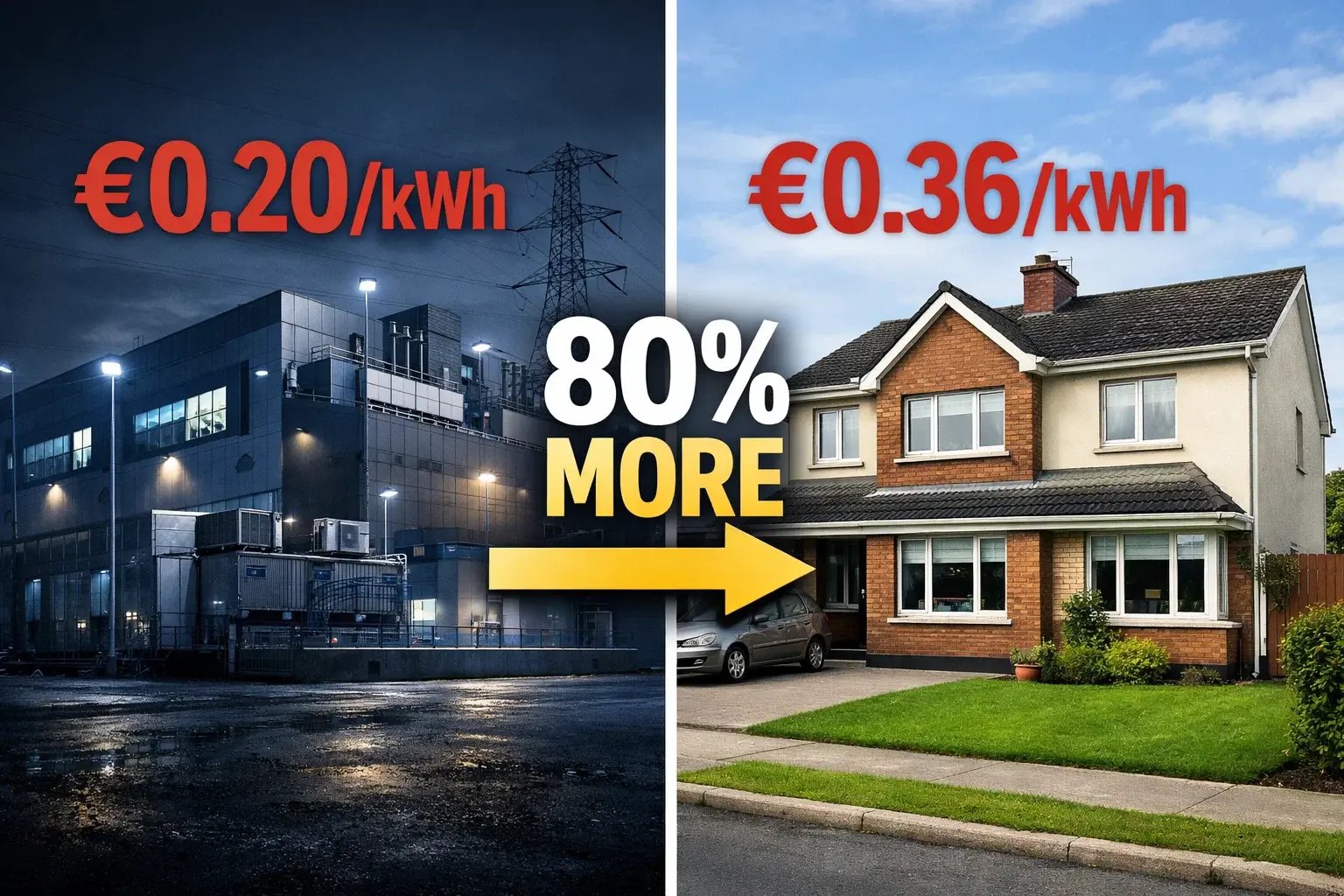
Irish households pay 7.6 cents per kWh in network charges to maintain the grid infrastructure. Data centres, despite using vastly more electricity and placing enormous strain on that same infrastructure, pay just 0.7 cents per kWh in network charges.
According to political analysis published in February 2026, this means the average Irish household is effectively subsidising data centre electricity costs while paying double the rate themselves.
Why This Matters for Your Home
1. You Are Competing for Limited Grid Capacity
Ireland's electricity grid was not designed to handle data centre growth at this scale. EirGrid's All-Island Resource Adequacy Assessment (February 2026) warns that electricity demand will exceed supply capacity during peak periods between 2026 and 2028.
The causes:
- Data centres adding 200 to 400 MW of new demand annually
- EV adoption accelerating (212,000+ EVs on Irish roads as of March 2026)
- Heat pump rollout (slow but growing)
- Delayed renewable generation projects
The result: When supply is tight, industrial users (including data centres) often have priority access to electricity because of their contractual arrangements with suppliers. Homeowners face the risk of higher prices during peak hours, potential supply interruptions, and rising grid upgrade costs passed through in bills (ESB Networks already added €1.75 per month to household bills from October 2025 to fund grid upgrades).
2. You Pay Double for the Same Electricity
The disparity in electricity costs is not just about volume discounts. It reflects a policy choice to offer preferential network charges to large industrial users while homeowners cover a disproportionate share of grid maintenance costs.
Annual cost comparison (4,200 kWh household consumption):
- Homeowner cost: 4,200 kWh × €0.36/kWh = €1,512 per year
- If homeowners paid data centre rates: 4,200 kWh × €0.20/kWh = €840 per year
- Extra cost for being a homeowner: €672 per year
Over 10 years, that is €6,720 more paid simply because you are a residential customer rather than an industrial one.
3. Government Policy Favours Data Centres, Not Homes
In December 2025, the Commission for Regulation of Utilities (CRU) announced a new policy: all data centres with a capacity of 1 MVA or more must prove that at least 80 per cent of their annual electricity demand is met by new renewable energy sources.
This is good climate policy. But notice what is missing: no equivalent requirement for Irish households to have access to affordable renewable energy, no subsidised solar installations for homeowners, no government-funded rooftop solar programme.
Data centres are effectively required (and supported) to build their own renewable electricity supply. Homeowners are left to navigate SEAI grants, installer quotes, and planning rules on their own.
The message is clear: if you want affordable, renewable electricity in Ireland, you need to build it yourself.
The Solution: Generate Your Own Electricity
The traditional response to rising electricity costs is to switch suppliers, reduce consumption, or accept higher bills. But in a grid increasingly dominated by data centres and large industrial users, those strategies have limited impact.
The better solution is to stop competing for grid electricity altogether.
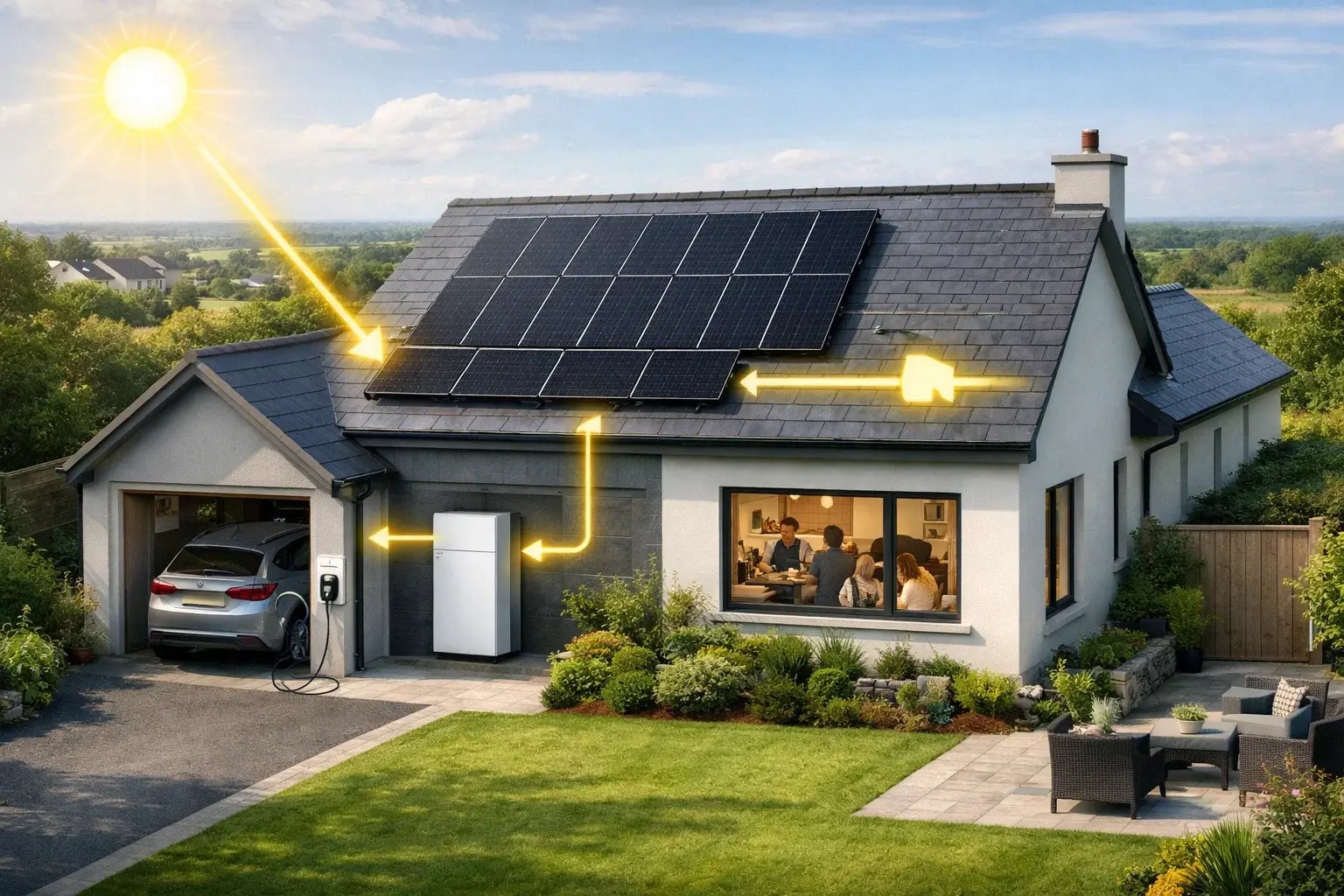
Solar panels and battery storage allow you to generate, store, and use your own electricity, removing you from the competition for limited grid capacity and insulating you from the pricing disparities that favour large users over homeowners.
How Solar + Battery Works
- Solar panels generate electricity during the day (even on cloudy days, though output is lower)
- You use that electricity in real-time (appliances, lights, devices, EV charging)
- Excess electricity either:
- Charges your home battery for use in the evening/night
- Exports to the grid (you get paid €0.13 to €0.20 per kWh via Clean Export Guarantee)
- At night, your battery powers your home (or you draw from the grid at night-rate tariffs if on a smart plan)
A typical 7 kWp solar system in Ireland generates approximately 6,500 kWh per year. The average Irish household uses 4,200 kWh per year. That means solar can cover your entire annual electricity consumption, with a surplus to export or store.
Cost of Energy Independence
| System | Annual Generation | Net Cost (After Grant) | Annual Savings | Payback Period |
|---|---|---|---|---|
| 7 kWp solar only | 6,500 kWh | €7,450 | €1,200–€1,400 | 5–6 years |
| 7 kWp solar + 5 kWh battery | 6,500 kWh | €10,000–€10,500 | €1,600–€1,900 | 5.5–6.5 years |
| 9 kWp solar + 10 kWh battery | 8,000 kWh | €13,500–€14,500 | €2,200–€2,500 | 5.5–6.5 years |
Savings based on 30–40% self-consumption (solar only) or 70–80% self-consumption (solar + battery), standard electricity rate €0.36/kWh, and Clean Export Guarantee payments.
At the time of writing, the SEAI offers a grant of up to €1,800 for solar PV installations, and solar systems are subject to 0% VAT, making the net cost significantly lower than the pre-grant price.
Over 25 years (the typical lifespan of solar panels), a 7 kWp system will save you approximately €30,000 to €35,000 in electricity costs compared to buying all your power from the grid. That figure increases if electricity prices continue to rise (as they have consistently since 2021).
Real-World Example: The Murphy Family, Cork
Situation:
- 4-bedroom semi-detached home
- Annual electricity consumption: 4,500 kWh
- Annual electricity cost (2026 grid rates): €1,620
- Two EVs (one commuter, one family car)
Before Solar:
- Competing with data centres for grid electricity
- Paying €0.36/kWh (data centres pay €0.20/kWh)
- Vulnerable to price spikes and supply constraints
- No protection against future electricity price increases
After Installing 7 kWp Solar + 10 kWh Battery (2024):
- System cost: €10,500 (after €1,800 SEAI grant)
- Annual generation: 6,500 kWh
- Self-consumption: 75% (4,875 kWh used directly, 1,625 kWh exported)
- Grid electricity purchased: 1,125 kWh per year (reduced from 4,500 kWh)
- Annual electricity cost: €405 (down from €1,620)
- Annual export income: €244 (1,625 kWh × €0.15/kWh average)
- Net annual savings: €1,459
- Payback period: 7.2 years
- 25-year savings: €36,475
Energy independence achieved: 75% of the Murphy family's electricity now comes from their own roof, not from the grid shared with data centres. They have opted out of the competition for limited grid capacity and locked in their electricity costs for the next 25 years.
What About Battery Storage?
Solar panels alone can cover your annual electricity consumption, but without a battery, you are limited to using solar electricity when the sun is shining. In practice, this means:
- Without battery: 30 to 40% self-consumption (you use solar during the day, buy grid electricity in the evening/night)
- With battery: 70 to 80% self-consumption (you use solar during the day, battery-stored solar in the evening/night)
A home battery (5 to 10 kWh capacity) costs approximately €2,500 to €7,000 depending on size and brand. While there is currently no SEAI grant for battery storage, batteries installed with solar are exempt from VAT (0% rate), reducing the effective cost.
Why a battery makes sense in Ireland's data-centre-dominated grid:
- Protection during peak hours: Batteries discharge during evening peak demand (6pm to 9pm), when grid electricity is most expensive and supply is tightest. You avoid competing with data centres during these critical hours.
- Preparation for dynamic tariffs: From June 2026, Irish suppliers will offer dynamic electricity tariffs where prices change every 30 minutes based on wholesale costs. Batteries let you charge during ultra-cheap overnight periods (potentially €0.02 to €0.08 per kWh) and discharge during expensive peak periods (€0.50+ per kWh).
- Backup power: Some battery systems offer limited backup functionality during grid outages, providing peace of mind as grid reliability faces pressure from growing demand.
- Energy independence: The closer you get to 100% self-consumption, the less you are affected by grid politics, data centre demand, or future price increases.
Why Data Centres Are Building Renewable Supply (And You Should Too)
The CRU's requirement that data centres meet 80% of their electricity demand with renewable energy is not charity. It is a recognition that Ireland's grid cannot sustain unlimited fossil-fuel-powered growth.
Data centres are responding by:
- Building on-site solar farms
- Signing power purchase agreements (PPAs) with wind farms
- Developing "Green Energy Parks" where data centres colocate with renewable generation
- Installing microgrids (Ireland's first data centre microgrid launched in Dublin in March 2026, powered by renewable energy independent of the grid)
The lesson for homeowners is simple: If data centres (which pay half your electricity rate) are investing billions in renewable energy to reduce grid dependence, you should be doing the same on a household scale.
Solar panels are your equivalent of a data centre's on-site solar farm. A home battery is your equivalent of a data centre's microgrid. Both technologies give you control over your electricity supply and costs, independent of what happens on the national grid.
How WattCharger Can Help You Opt Out of the Grid Competition
WattCharger specialises in helping Irish homeowners achieve energy independence through solar PV systems, battery storage, and smart EV chargers.
Our Solar + Battery Packages
Solar Only (Best for Budget-Conscious Homeowners):
- 5 kWp system (10 panels): ~€6,000 after grant, generates 4,700 kWh/year
- 7 kWp system (14 panels): ~€7,450 after grant, generates 6,500 kWh/year
- 9 kWp system (18 panels): ~€8,900 after grant, generates 8,000 kWh/year
Solar + Battery (Best for Maximum Energy Independence):
- 7 kWp solar + 5 kWh battery: ~€10,000 after grant, 70% self-consumption
- 9 kWp solar + 10 kWh battery: ~€14,000 after grant, 80% self-consumption
All systems include:
- Premium solar panels (25-year performance warranty)
- Hybrid inverter (battery-ready for future expansion)
- Full installation by SEAI-registered, Safe Electric-certified installers
- SEAI grant application handled on your behalf
- Monitoring app to track generation, self-consumption, and savings in real-time
Optional Add-Ons
- Smart EV charger (Zappi, Ohme): From €805 (after €300 SEAI grant), integrates with solar to charge your EV using free solar electricity instead of expensive grid power
- Future battery addition: All our solar systems are designed with battery-ready inverters, so you can add storage later when budget allows
Our Honest Assessment
When you contact WattCharger for a free consultation, we will:
- Assess your home – Roof orientation, shading, electrical capacity, annual consumption
- Calculate your savings – Real payback period based on your actual usage, not inflated marketing claims
- Explain trade-offs – Solar only vs solar + battery, system sizing, budget options
- Design your system – Optimised for your roof and your energy goals
- Handle all paperwork – SEAI grants, Safe Electric certification, supplier notifications
We will tell you if solar is not a good fit for your home. Our goal is to help you achieve energy independence, not to sell you technology you do not need.
Final Thoughts
Ireland's electricity grid is increasingly dominated by data centres that consume one-third of national supply while paying half what homeowners pay. This is not a sustainable or fair arrangement, and homeowners are bearing the cost in higher bills, grid constraints, and supply uncertainty.
You cannot change government energy policy. You cannot force data centres to pay residential electricity rates. But you can stop competing with them for grid electricity.
Solar panels and battery storage are not luxuries or environmental statements. They are strategic investments that give you control over your electricity supply, insulate you from grid politics, and lock in your energy costs for 25 years. Data centres are building their own renewable electricity supply because it makes financial and strategic sense. You should be doing the same.
The 94,000 Irish homeowners who have already installed solar are not early adopters taking a risk. They are pragmatists who recognised that the grid is not built to serve them anymore, and they chose to build their own energy independence.
The question is not whether solar makes sense in Ireland. It is whether you want to keep paying €0.36 per kWh to compete with data centres, or whether you want to generate your own electricity at €0.12 per kWh (the effective cost of solar over 25 years) and opt out of the competition entirely.
Ready to Generate Your Own Electricity?
Stop competing with data centres for grid power. Join thousands of Irish homeowners already saving with solar and battery storage. Get in touch with WattCharger for a free consultation and personalised quote. We handle everything from system design to SEAI grant paperwork, so you can start generating your own electricity with confidence.
Blog Author: Rowan Egan