


Ireland's Grid is Under Pressure 2026-2028: Why Home Solar + Battery is Your Best Defence
On 26 February 2026, EirGrid, Ireland's national grid operator, issued a stark warning: the country faces "a potentially challenging situation" in meeting electricity demand between 2026 and 2028. The operator's annual All-Island Resource Adequacy Assessment revealed that the grid will struggle to balance supply and demand as electricity consumption grows faster than new generation capacity comes online.
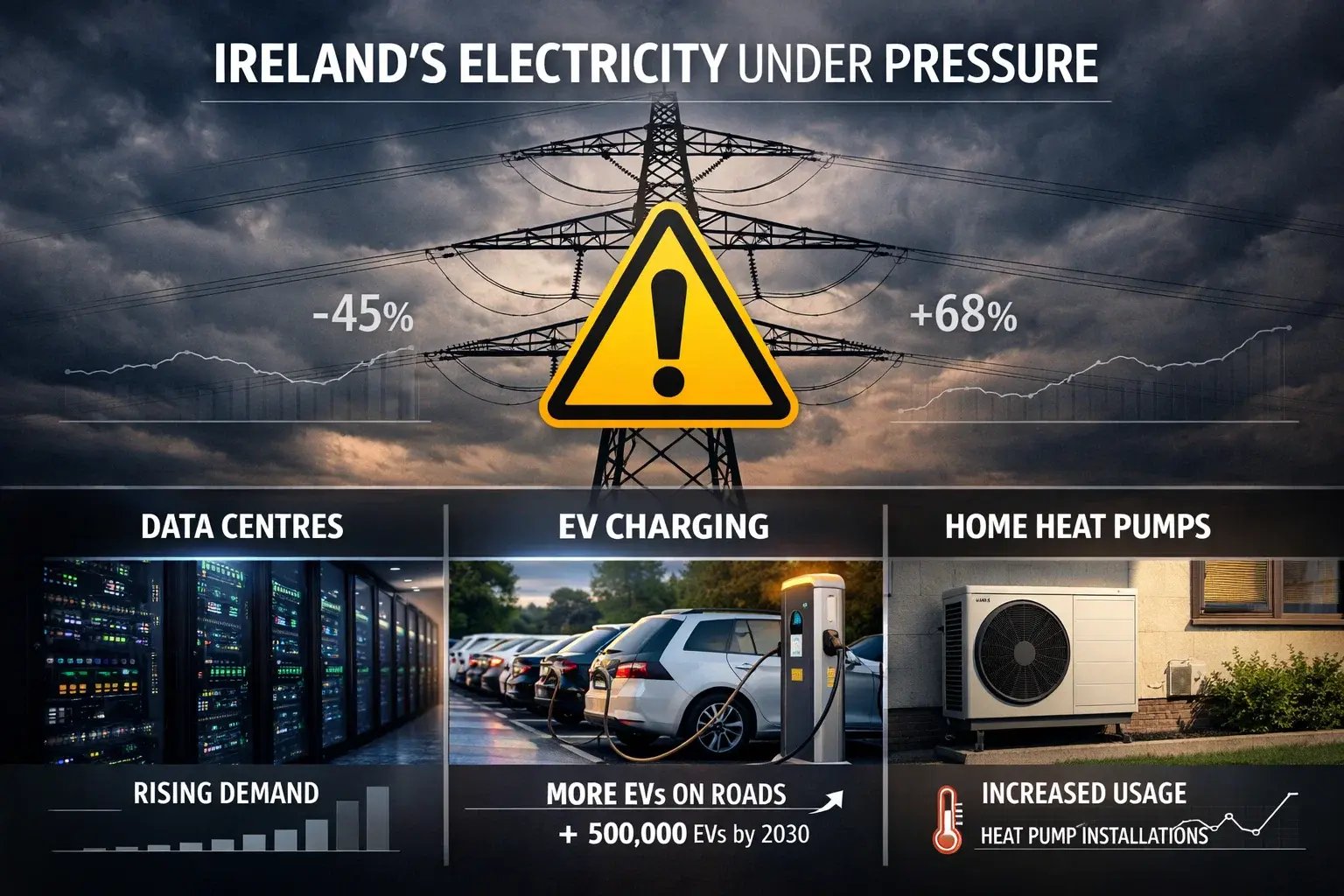
The pressure comes from multiple directions:
- Data centres consuming an ever-larger share of power (currently 20 to 22%, projected to reach 30% by the early 2030s)
- Electric vehicles adding significant load as adoption accelerates (over 212,000 on Irish roads)
- Heat pumps replacing oil and gas heating in homes nationwide
- Delays in new generation capacity coming to market
EirGrid's head of Power System Insights, Marc Senouci, confirmed the grid will need 200 to 400 megawatts (MW) of additional generation capacity in the early 2030s to meet demand. To bridge the gap, Temporary Emergency Generation facilities and the Moneypoint Power Plant in Co. Clare are on standby as "critical back-up generation" to prevent shortfalls.
For Irish homeowners, this warning is more than a technical report. It is a signal that centralised grid reliability can no longer be taken for granted. The solution? Distributed energy generation and storage. In plain terms: solar panels and home batteries.
The Numbers: Why the Grid is Under Strain
EirGrid's assessment paints a sobering picture of Ireland's electricity system over the next decade.
Demand Growth is Accelerating
- January 2026: Ireland's electricity demand hit 4,087.9 gigawatt-hours (GWh), a 4.5% increase from January 2025, the highest January demand ever recorded.
- 2026 to 2030: EirGrid expects "a steeper growth in demand" driven by electrification of transport and heating.
- 2030 to 2035: Growth continues at a "steadier increase", but still substantial.
Translation: Ireland will need significantly more electricity every year for the next decade.
Data Centres: The Elephant in the Grid
Data centres have become Ireland's largest and fastest-growing electricity consumers. As of early 2026:
- Data centres consume approximately 20 to 22% of Ireland's total electricity demand
- By the early 2030s, that figure is projected to rise to 30 to 32%
- This means nearly one-third of all electricity generated in Ireland will power data centres, not homes, schools, or hospitals
Marc Senouci noted: "As we move into the next decade, we are seeing that rise closer to the low 30s percentage perspective."
That is the equivalent of two million Irish homes' worth of electricity redirected to server farms.
Supply is Not Keeping Pace
While demand surges, new generation capacity is struggling to keep up:
- Renewable projects face delays due to grid connection bottlenecks, planning permission backlogs, and supply chain constraints
- Gas-fired plants remain necessary for baseload and backup power, but investment in new capacity has been slow
- Coal is gone: Moneypoint ceased coal-fired generation in June 2025 after 40 years. While it can still operate in emergencies until 2029, it is no longer a primary power source
The result: EirGrid's report shows the system will be outside the Reliability Standard (defined as no more than 3 hours of unmet demand per year) between 2026 and 2028 under multiple scenarios.
What "Outside the Reliability Standard" Means
In plain language: there is a risk of electricity shortages during periods of high demand or low renewable output (calm winter evenings, for example). EirGrid will deploy emergency generation and potentially issue alerts asking consumers to reduce usage during critical periods.
Ireland has not experienced widespread blackouts, but the risk of brownouts, rolling demand reduction, or industrial load curtailment is now on the table.
Why Homeowners Should Pay Attention
You might think, "This sounds like a problem for the government and energy companies, not me." But grid strain affects every household in several ways:
1. Higher Electricity Prices
Grid operators pass infrastructure costs to consumers. The €18.9 billion grid upgrade approved in December 2025 will add approximately €1.75 per month (€21/year) to household bills. As the grid struggles to meet demand, peak-time electricity prices may rise further to manage load.
2. Potential for Demand Management
When the grid is under severe stress, EirGrid can issue Amber Alerts or Red Alerts, asking consumers to reduce electricity usage voluntarily. In extreme cases, large industrial users (and eventually, domestic smart meter customers) could face load curtailment, where power is temporarily reduced or cut during peak demand.
3. Reliance on Fossil Fuel Backup
To keep the lights on during tight supply periods, Ireland will increasingly lean on gas-fired plants and emergency generators. This undermines climate targets and locks in fossil fuel dependency, even as renewable capacity grows.
4. Vulnerability to External Shocks
If a major power plant goes offline unexpectedly, or if wind generation drops during a cold snap, the grid has less margin for error. Homeowners who rely 100% on the grid are fully exposed to these risks.
The Solar + Battery Solution: Energy Independence
The grid's vulnerability creates a compelling case for distributed energy generation. Instead of relying entirely on a strained centralised system, homeowners can generate and store their own electricity, reducing grid dependence and protecting against supply disruptions.
How It Works
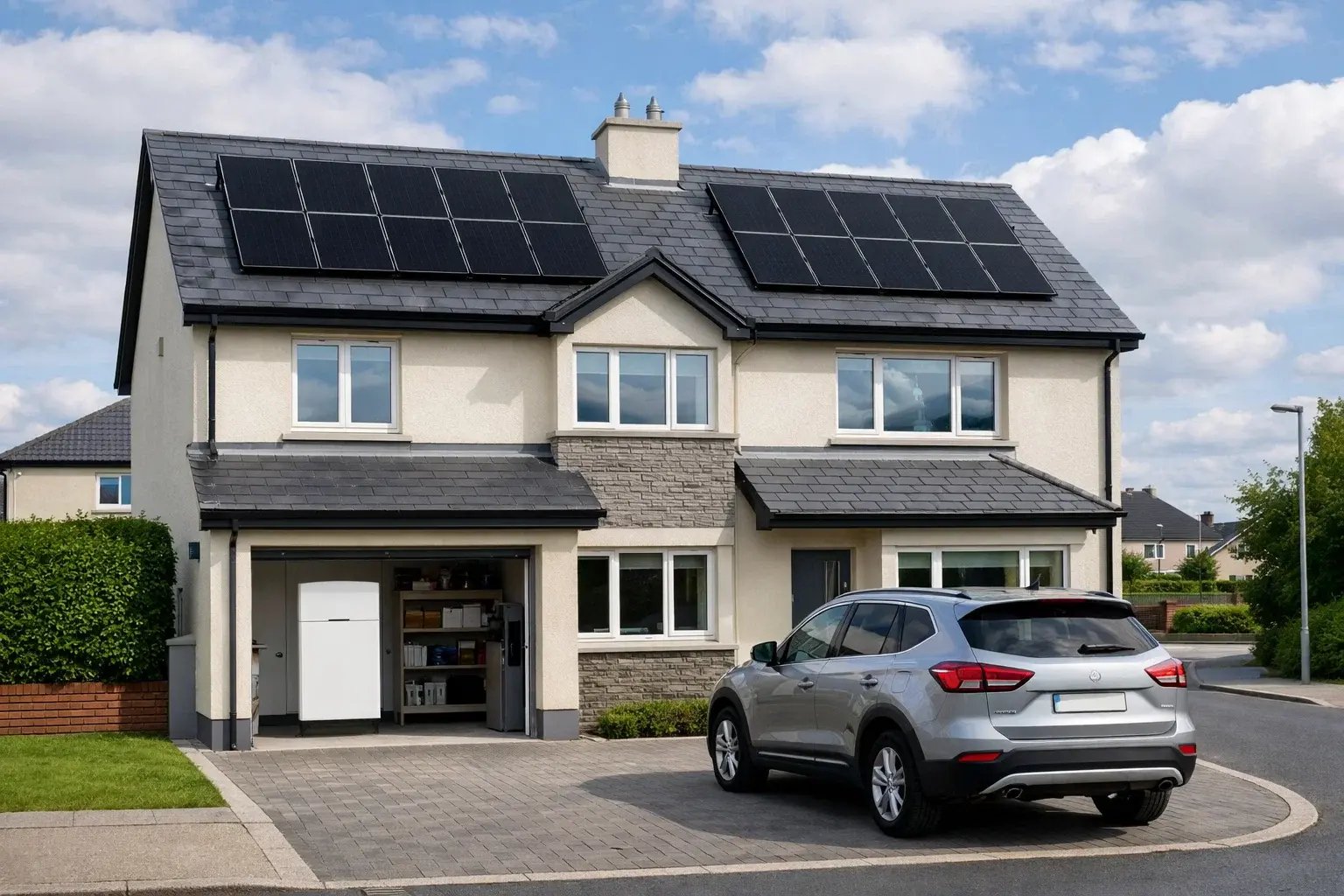
Solar panels generate electricity during daylight hours. A home battery stores surplus energy for use in the evening and overnight, when the grid is most strained and electricity is most expensive.
Example: 7 kWp Solar System + 10 kWh Battery
| Metric | Value |
|---|---|
| Solar system size | 7 kWp (14 panels) |
| Annual generation | 6,500 kWh |
| Battery capacity | 10 kWh |
| Self-consumption (without battery) | 30-35% (2,000-2,300 kWh) |
| Self-consumption (with battery) | 70-80% (4,550-5,200 kWh) |
| Grid independence | 70-80% of annual electricity needs met by solar + battery |
What this means:
- You generate and consume 4,550 to 5,200 kWh per year from your own rooftop
- You only draw 1,300 to 1,950 kWh per year from the grid (down from 6,500 kWh without solar)
- During summer months, you can achieve near-complete energy independence
- During winter, your system still covers 40 to 50% of your needs
The Economics: Cost and Savings
System cost (2026):
- 7 kWp solar panels: €9,250 (before grant)
- SEAI grant: €1,800
- Net solar cost: €7,450
- 10 kWh home battery: €5,000 to €7,000 (no grant, but 0% VAT)
- Total system cost: €12,450 to €14,450
Annual savings:
- Electricity avoided (4,550 kWh at €0.36/kWh): €1,638
- Export income (1,300 kWh surplus at €0.20/kWh): €260
- Total annual benefit: €1,898
Payback period: 6.5 to 7.6 years
25-year savings: Approximately €47,000 (after deducting initial investment)
The Security Premium
Beyond pure economics, solar + battery provides energy security. During grid alerts or outages, your home continues to operate on stored solar energy. While your neighbours manage candlelit dinners, your lights, fridge, and internet stay on.
This "insurance premium" is increasingly valuable as grid reliability becomes less certain.
Real-World Example: A Dublin Family's Energy Independence
Consider a family of four in Clondalkin, Dublin:
Before Solar + Battery:
- Annual electricity consumption: 5,200 kWh
- Grid reliance: 100%
- Annual electricity cost (at €0.36/kWh): €1,872
- Exposure to grid failures: Complete
After Installing 7 kWp Solar + 10 kWh Battery:
- Annual solar generation: 6,500 kWh
- Self-consumption: 4,000 kWh (77%)
- Export: 2,500 kWh (€500 at €0.20/kWh)
- Grid import (winter top-up): 1,200 kWh (€432)
- Annual electricity cost: €432
- Annual saving: €1,440
- Grid independence: 77%
During EirGrid's projected "challenging" 2026-2028 period, this family is insulated from:
- Peak-time price spikes
- Demand reduction requests
- Short-term grid supply issues
Their energy security is self-generated, not grid-dependent.
Addressing the Data Centre Debate
Some readers will ask: "Why should homeowners invest in solar when data centres are consuming 30% of the grid?"
Fair question. Here is the reality:
Data Centres Are Here to Stay
Ireland's digital economy employs tens of thousands, generates billions in tax revenue, and underpins multinational investment. Data centres are not going away. The government has imposed planning restrictions on new data centre developments in Dublin, but existing facilities will continue operating and expanding.
Distributed Solar Reduces Grid Strain
Every kilowatt-hour generated by rooftop solar is one less kilowatt-hour the grid must supply during peak daylight hours. If 10% of Irish households (≈175,000 homes) installed 5 kWp solar systems, that would add approximately 1.6 GW of distributed capacity, equivalent to two large power stations.
Distributed solar reduces grid pressure; it does not add to it.
Batteries Provide Peak Shaving
Home batteries charge during the day (when solar generation is high and grid demand is moderate) and discharge in the evening (when demand peaks). This flattens the demand curve, making it easier for the grid to balance supply.
Grid-scale batteries are already doing this. Ireland now has over 1 GW of grid-scale battery storage, which cut fossil fuel generation by 400 MW on high-demand days in late 2025. Home batteries deliver the same benefit at the household level.
Government Policy is Supporting Home Energy
Despite the grid challenges, government policy actively encourages home solar and battery adoption:
SEAI Grants
- Solar PV grant: €1,800 (2026) for rooftop installations
- 0% VAT on solar panels and batteries (since May 2023)
- Clean Export Guarantee (CEG): Homeowners receive €0.13 to €0.20/kWh for surplus electricity exported to the grid
Grid Investment
The €18.9 billion grid upgrade (2026-2030) will accommodate more distributed generation, making it easier to connect home solar systems and export surplus energy.
Renewable Electricity Targets
Ireland aims for 80% of electricity from renewables by 2030. Rooftop solar is a core part of that strategy. As of March 2026, Ireland has surpassed 1 GW of rooftop solar capacity (over 94,000 homes).
What to Do Now
If you are a homeowner with a suitable roof and off-street parking, 2026 is an ideal time to invest in solar + battery:
Step 1: Get a Free Solar Assessment
Contact WattCharger for a no-obligation site survey. We assess your roof orientation, shading, electricity usage, and budget to design a system tailored to your needs.
Step 2: Size Your System Appropriately
- Typical 4-person household: 5 to 7 kWp solar system
- Larger household or EV owner: 7 to 10 kWp system
- Battery size: 5 kWh minimum, 10 kWh ideal for maximising self-consumption
Step 3: Secure Grants and Finance
WattCharger handles SEAI grant applications on your behalf. The €1,800 grant typically processes within 8 to 12 weeks after installation.
Optional: low-interest Home Energy Upgrade Loans (from €5,000 to €75,000 at 2.99% APR) are available through AIB, Bank of Ireland, and PTSB.
Step 4: Installation (1-2 Days)
Our SEAI-registered installers complete most residential installations in one to two days. Systems go live immediately after connection and safety testing.
Step 5: Monitor and Optimise
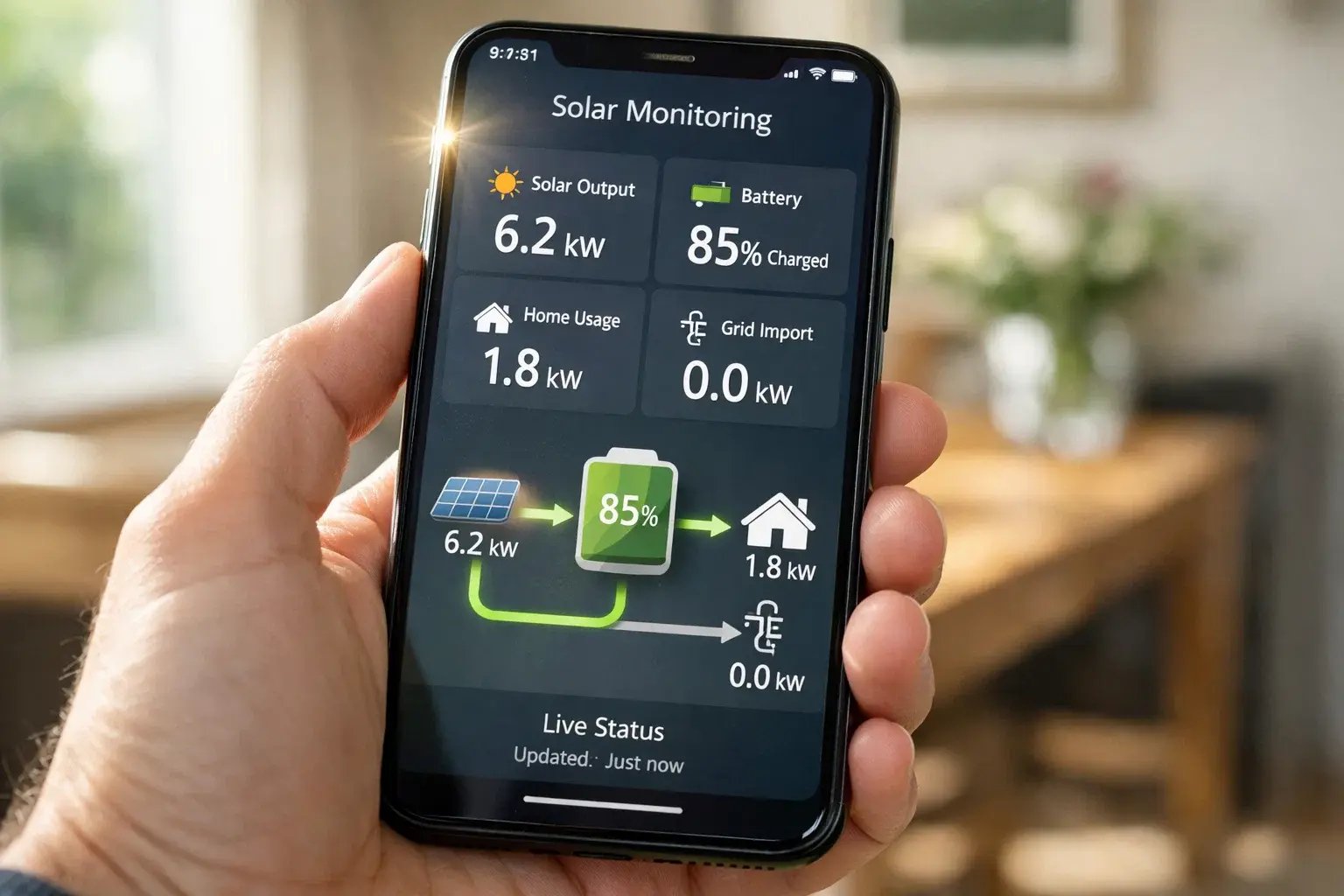
Modern solar systems include monitoring apps that show real-time generation, consumption, battery charge, and grid import/export. You will see your energy independence increase day by day.
Final Thoughts
EirGrid's warning is not scaremongering; it is a realistic assessment of Ireland's electricity system under unprecedented strain. Data centres, EVs, and heat pumps are driving demand growth faster than new generation can be added. The grid will remain tight through 2028 and potentially beyond.
For homeowners, this creates both a risk and an opportunity. The risk is continued reliance on a stressed grid with rising prices and potential supply disruptions. The opportunity is energy independence through solar panels and home batteries.
A 7 kWp solar system with a 10 kWh battery delivers 70 to 80% energy independence, cutting your grid reliance to a fraction of what it was. You generate free electricity for 25+ years, store it for evening use, and protect yourself against future grid volatility.
The grid is under pressure. Your home does not have to be.
Ready to Take Control of Your Energy?
WattCharger has installed solar and battery storage systems for thousands of Irish homeowners across every county. We handle everything: system design, SEAI grants, professional installation, and after-sales support.
Get in touch for a free consultation and quote. While the grid struggles to keep up, your home can generate its own power. Energy independence starts on your roof.
Blog Author: Rowan Egan