


Zero Wind Farms Approved in Q1 2026 – Why 10,000+ Homeowners Chose Rooftop Solar Instead
On 8 May 2026, Wind Energy Ireland released a damning quarterly planning report: An Coimisiún Pleanála, Ireland's national planning authority, approved zero new wind farms in the first quarter of 2026 – down from seven projects (402 MW) approved during the same period in 2025.
The numbers are stark:
- Zero wind farms approved January-March 2026
- Nine projects (592 MW) waiting over one year for decisions
- Six projects (406 MW) stuck in planning for over two years
- Nearly 1,000 MW of renewable energy capacity trapped in bureaucracy
- 40 wind projects currently in the planning system, representing Ireland's energy security future
According to the Wind Energy Ireland report and RTÉ Primetime coverage, this planning paralysis comes at the worst possible time: Ireland faces the highest electricity prices in the EU (€0.404/kWh), wholesale prices that spike to €201/MWh on low-wind days, and renewed exposure to volatile global fossil fuel markets.
Yet while utility-scale wind projects languish in planning limbo for 2-5+ years, 10,000+ Irish homeowners installed rooftop solar in Q1 2026 alone – with no planning permission required and installations completed in 4-8 weeks.
The contrast couldn't be clearer: government-scale renewable energy is stuck in bureaucracy. Individual action is moving at pace.
The Planning Bottleneck: Why Wind Farms Wait Years While Solar Takes Weeks
Ireland's planning system differentiates sharply between utility-scale renewable projects and residential installations:
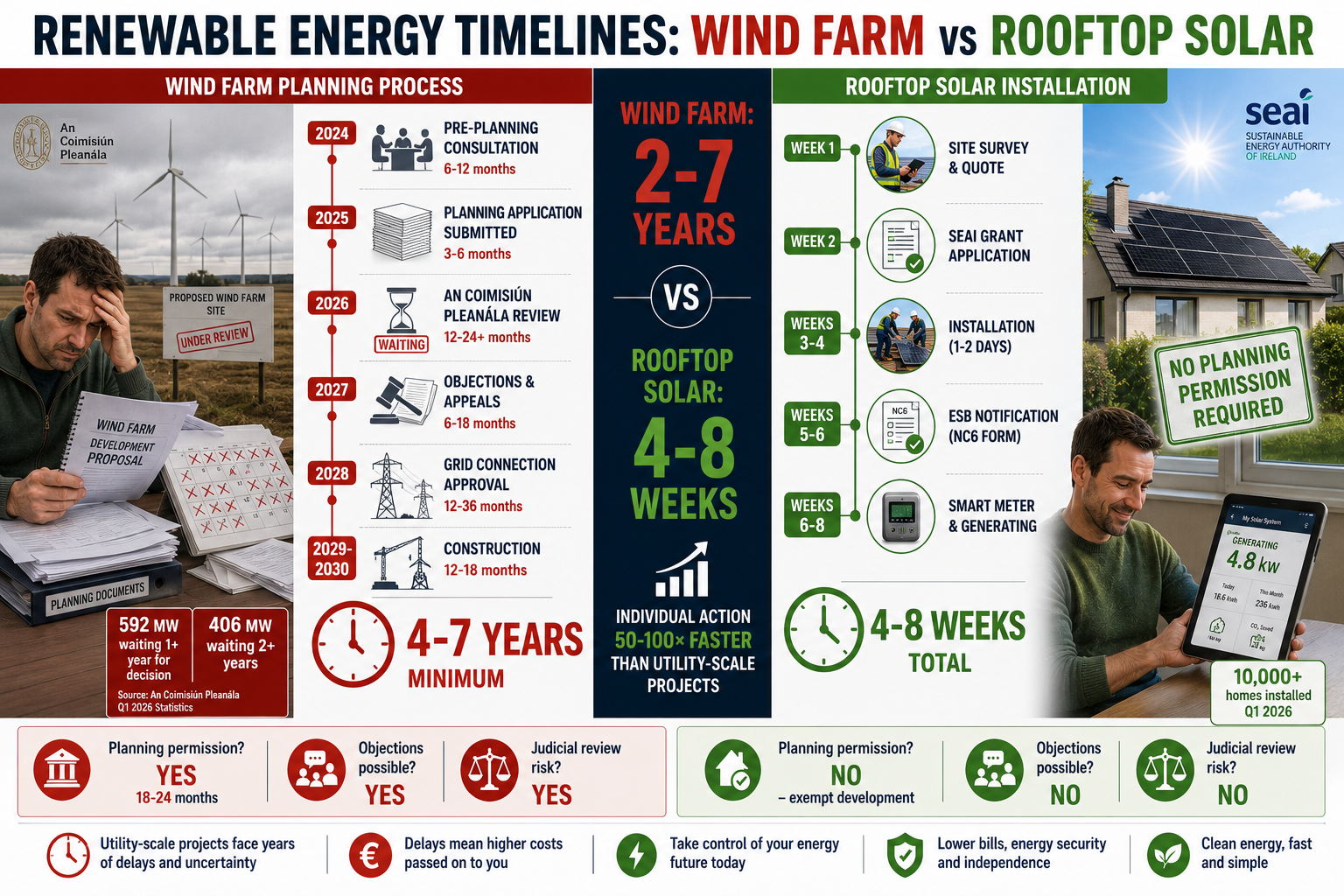
Wind Farm Planning Process (2-7+ Years)
| Stage | Typical Duration | Key Challenges |
|---|---|---|
| Pre-planning consultation | 6-12 months | Community engagement, environmental surveys, noise studies |
| Planning application | 3-6 months | Detailed environmental impact assessments, wind data, grid connection studies |
| An Coimisiún Pleanála review | 12-24+ months (statutory: 18 weeks) | Submissions from locals, environmental groups, state bodies |
| Objections & appeals | 6-18 months | Judicial reviews, clarifications, additional information requests |
| Grid connection approval | 12-36 months | Separate process, often runs parallel but can delay construction |
| Construction | 12-18 months | Once all approvals secured |
Total: 4-7 years minimum from concept to electricity generation (often longer with objections)
Rooftop Solar Planning Process (4-8 Weeks)
| Stage | Typical Duration | Key Requirements |
|---|---|---|
| Site survey & quote | 1-2 weeks | Free assessment, roof suitability check |
| SEAI grant application | 1-2 weeks | Installer handles paperwork |
| Installation | 1-2 days | SEAI-registered electricians |
| ESB Networks notification (NC6 form) | 1-2 weeks | Grid connection paperwork for export |
| Smart meter installation | 2-4 weeks | ESB schedules after notification |
Total: 4-8 weeks from decision to generating electricity
Planning permission required: None (for rooftop systems under 300m² and ground-mounted under 25m²)
The reason is simple: since October 2022, Irish planning law exempts most domestic solar installations from planning permission requirements. Rooftop solar panels are classified as "exempted development" as long as they:
- Are mounted on pitched roofs
- Don't protrude more than 50cm from the roof surface
- Remain 50cm from roof edges
- Don't exceed 300m² (approximately 600 panels – far beyond typical residential capacity)
Ground-mounted solar is exempt if:
- The array doesn't exceed 25m²
- It's at least 5 metres from site boundaries
For context, a typical 7 kWp residential solar system uses 14 panels covering approximately 28m² – well within exemption limits.
What's Causing the Wind Farm Planning Crisis?
Wind Energy Ireland CEO Noel Cunniffe explained the frustration: "At a time when Ireland is again exposed to the volatility of global fossil fuel markets, Irish wind farms reduce our reliance on imports and strengthen our supply of clean, local, electricity... nearly 1,000 MW of projects have been waiting over a year for a decision which is extremely frustrating."
An Coimisiún Pleanála responded that delays stem from:
- Requests for further information from applicants to assist in final decisions
- Risk of judicial review if possible gaps in information aren't addressed
- Submission volumes from local residents, environmental groups, and state bodies
- Statutory deadline pressures – the RED III (Renewable Energy) Directive requires decisions within 52 weeks for onshore projects, but actual timelines often exceed this
The 2025 planning figures tell the story of a broken system:
- 15 wind projects approved (626 MW total capacity)
- 88% approval rate once decisions are made (up from 45% in 2024)
- But fewer decisions published than 2023 or 2024
- Growing backlog of 40 projects currently in the system
Translation: when wind projects eventually get decisions, they're usually approved – but getting to that decision takes years, and the backlog keeps growing.
The 10,000+ Homeowners Who Didn't Wait
While An Coimisiún Pleanála deliberated on 592 MW of wind capacity stuck in year-two of planning limbo, Irish homeowners took matters into their own hands. According to PV Magazine and SEAI data, over 10,000 solar PV applications were submitted in Q1 2026 – a 65% year-on-year increase.
These installations represent approximately:
- 70-80 MW of distributed solar capacity (assuming average 7 kWp per installation)
- 65-75 million kWh of annual generation (enough for ~15,000 homes)
- €30-40 million in household electricity savings over 25 years
- Zero planning delays, objections, or judicial reviews
Unlike wind farms that require years of community consultation, environmental impact assessments, and planning board deliberations, rooftop solar installations face no such barriers. The homeowner decides, the installer delivers, and electricity generation begins within weeks.
Tired of waiting for government-scale renewable energy while paying €0.404/kWh? See if your home qualifies for no-planning-permission solar installation in 4-8 weeks.
Why Rooftop Solar Bypasses Planning Entirely
The planning exemption for residential solar exists because rooftop installations:
1. Have Minimal Visual Impact
Solar panels sit flat on existing roofs, following the roofline. Unlike wind turbines that stand 80-150 metres tall and are visible for kilometres, solar panels blend into residential streetscapes.
2. Generate No Noise
Wind turbines produce 35-45 decibels of sound at 300 metres – a common objection in planning submissions. Solar panels are completely silent.
3. Don't Require Site Changes
Solar installations use existing roof structures. No new roads, no construction traffic, no landscape alteration. Ground-mounted systems under 25m² are small enough to integrate into gardens without environmental disruption.
4. Have No Shadow Flicker or Rotating Components
Wind turbine shadow flicker (rotating blade shadows cast on nearby properties) is a frequent planning objection. Solar panels remain stationary and don't cast moving shadows.
5. Connect to Existing Distribution Networks
Rooftop solar connects to local distribution networks at the household level. Wind farms often require new transmission lines and substations – adding years to planning timelines.
6. Face Limited Neighbour Objections
Because visual and noise impacts are minimal, neighbours rarely object to residential solar. Planning permission isn't needed because there's typically nothing to object to.
The Renewable Energy Gap: What 1,000 MW of Stalled Wind Projects Means
The 1,000 MW of wind capacity stuck in planning for 1-2+ years represents:
- Annual generation potential: ~3,000 GWh (enough to power 700,000 homes)
- Fossil fuel displacement: €450-600 million worth of imported gas per year
- Wholesale price impact: On high-wind days, electricity costs €99-115/MWh; on low-wind days, €191-201/MWh – a 75% price swing
- Carbon emissions avoided: ~1.5 million tonnes CO₂ annually
- Lost economic opportunity: €1-1.5 billion in construction investment, 1,000+ construction jobs
This isn't just a planning problem – it's an energy security and affordability crisis.
Wind Energy Ireland's report highlights that Ireland's Climate Action Plan targets 80% renewable electricity by 2030 (requiring 9 GW of onshore wind). Currently, wind provides 55.6% of renewable electricity, with renewables overall at 40.2% of the grid. The gap is widening, not closing.
Every year of planning delay is a year of continued fossil fuel dependence, higher electricity bills, and missed climate targets.
Why Homeowners Are Choosing Solar Over Waiting for Government Projects
For the 10,000+ homeowners who installed solar in Q1 2026, the logic was straightforward:
1. Immediate Control Over Energy Costs
Rooftop solar locks in electricity generation at €0.046/kWh (lifetime system cost ÷ total generation) versus grid electricity at €0.404/kWh. That's an 89% cost reduction for self-consumed electricity.
A 7 kWp system generates 6,500 kWh per year – worth €2,626 at current grid rates. With 35% self-consumption (solar-only, no battery), annual savings are €776 after accounting for remaining grid purchases and export income.
Waiting for wind farms to solve Ireland's energy problem? You'll still pay €0.404/kWh. Installing solar today? You pay €0.046/kWh for 25+ years.
2. No Planning, No Delays, No Objections
Unlike wind developers who must navigate:
- Community consultation meetings
- Environmental impact assessments (noise, shadow flicker, bird migration studies)
- Lengthy planning submissions (often 500+ page documents)
- Objection periods and appeals
- Judicial review risks
...homeowners face zero bureaucratic barriers. Call installer → site survey → installation → generating power. Total: 4-8 weeks.
3. Energy Independence During Grid Crises
EirGrid warned in February 2026 of a "potentially challenging situation" meeting electricity demand 2026-2028. Ireland's reliance on emergency gas generation (€1.52 billion spent to date on four temporary power plants) keeps wholesale prices volatile.
Rooftop solar provides immediate supply security independent of grid constraints, fossil fuel prices, or planning bottlenecks. When wholesale electricity hits €201/MWh on low-wind days (as it did in April 2026), solar homeowners generate at €0.046/kWh – unaffected by market chaos.
4. Government Support Without Government Delays
The SEAI solar grant (€1,800) doesn't require planning approval – just proof of installation by a registered electrician. Installers handle the grant paperwork in parallel with installation, adding no delays.
In contrast, wind projects may wait years for planning approval before accessing government supports or grid connection offers.
5. Proven Track Record vs Uncertain Timelines
Ireland has successfully installed solar on 177,000+ homes and businesses since the technology became widely available. The process is well-established, reliable, and fast.
Wind farm planning timelines, by contrast, remain unpredictable. Will your project wait one year or three? Will a single objection trigger a judicial review? Will An Coimisiún Pleanála request additional information six months into review?
Homeowners choosing solar eliminate this uncertainty entirely.
What About the April Turnaround?
Wind Energy Ireland noted a positive development: three wind farms were approved by An Coimisiún Pleanála in April 2026, after zero approvals in Q1.
CEO Noel Cunniffe commented: "On a more positive note, it is encouraging to see three new wind farms approved... This trend needs to continue to build positive momentum."
However, three approvals in one month doesn't resolve the structural issue: 15 projects (998 MW) are still waiting over one year for decisions, and the backlog of 40 projects continues to grow faster than An Coimisiún Pleanála can process applications.
Even if the April pace continues (3 approvals per month), it would take over a year to clear the current backlog – during which time new applications will arrive, and existing projects will face potential objections, judicial reviews, and requests for further information.
For homeowners deciding whether to wait for grid improvements or install solar today, the April approvals change nothing. Your rooftop solar will be generating for 1-2 years before those three April wind farms begin construction.
Final Thoughts: The Gap Between Policy and Action
Ireland's zero wind farm approvals in Q1 2026 expose a fundamental problem: the planning system designed for traditional infrastructure projects cannot accommodate the pace and scale of renewable energy transition required to meet 2030 climate targets.
Wind farms are essential for Ireland's energy future. The 1,000 MW currently trapped in planning – representing enough electricity for 700,000 homes – must be approved and built. An Coimisiún Pleanála's commitment to the RED III Directive's 52-week statutory deadline is welcome, but actual timelines must match statutory commitments.
Yet for individual homeowners facing €0.404/kWh electricity bills (the highest in the EU), wholesale price swings from €99/MWh to €201/MWh depending on wind availability, and ongoing energy insecurity, waiting for the planning system to reform is not a viable strategy.
The 10,000+ homeowners who installed rooftop solar in Q1 2026 understood this. They recognised that:
- Individual action is faster than institutional reform (4-8 weeks vs 2-7 years)
- Distributed generation faces no planning barriers (exempted development vs multi-year reviews)
- Energy independence beats grid dependence (locked-in €0.046/kWh vs volatile €0.404/kWh)
- Control over costs beats waiting for policy solutions (immediate savings vs uncertain timelines)
The planning crisis for wind farms isn't a reason to delay personal renewable energy adoption – it's the reason to accelerate it.
Ready to Generate Renewable Energy in 4-8 Weeks, Not 4-8 Years?
Join 177,000+ Irish homes and businesses already generating clean electricity with rooftop solar – no planning permission required, no objections, no delays. Get your free assessment from WattCharger and start saving while wind farms wait for approval.
Blog Author: Rowan Egan