


On 23 April 2026, Energy Minister Darragh O'Brien told the Dáil he is "very open" to legalising plug-in solar panels in Ireland, a move that could finally bring solar power to the country's 600,000+ apartment dwellers and renters. Under current regulations, all solar panels must be installed by professional electricians and registered with ESB Networks, effectively locking out anyone without roof access or landlord permission.
Plug-in solar systems, typically 300W to 800W panels you mount on a balcony and plug directly into a wall socket like a kettle — are sold in supermarkets across Germany, Austria and the Netherlands. Ireland's ban has left renters and apartment owners on the sidelines while 100,000+ homeowners have installed traditional rooftop systems.
What Are Plug-In Solar Panels?
Plug-in solar (also called "balcony solar" or "micro solar") consists of:
- 1–3 solar panels (usually 300–800W total)
- Micro-inverter (converts DC to AC electricity)
- Standard plug that connects to any household socket
You mount the panels on a balcony railing, wall bracket, or even a garden stand, plug them in, and they immediately start feeding electricity into your home's circuit. When your fridge, lights or phone charger draw power, they use the solar electricity first, reducing what you pull from the grid.
Key features:
- No electrician required (in countries where legal)
- No ESB registration needed
- Installation time: 15–30 minutes
- Cost: €400–€800 for a complete kit
- Output: 300–1,200 kWh per year (depending on size and orientation)
- Payback: 2–4 years
Why Are They Illegal in Ireland?
Irish regulations (governed by the Safe Electric code and ESB Networks connection rules) require:
- All grid-connected solar must be installed by a registered electrician
- NC6 form submission to ESB Networks before installation
- Smart meter installation (currently 6–12 week wait)
- Electrical inspection certificate
These rules were written for traditional rooftop systems (3–9 kW) and haven't been updated for micro-generation. The stated concerns are:
- Safety during outages — fear that solar could back-feed into the grid and electrocute linesmen
- Grid stability — worry about thousands of unregistered systems affecting power quality
- Fire risk — concern about DIY installations
However, modern plug-in systems solve all three issues:
- Anti-islanding protection — micro-inverters automatically shut off within 0.2 seconds if grid power drops, preventing back-feed
- Grid-following technology — they synchronise with grid frequency and can't destabilise it
- TÜV/CE certification — European plug-in kits meet strict safety standards
Germany has had plug-in solar since 2018 with over 700,000 installations and zero reported grid incidents. The UK announced in March 2026 it would regulate (legalise) plug-in solar by June 2026.
The Dáil Debate (15–23 April 2026)
Independent TD Barry Heneghan challenged Minister O'Brien on 15 April:
"Apartment dwellers cannot use their rooftop. The plug-in solar systems which can be bought and installed within 15 minutes are a simple fix that would reduce their energy costs. Let's not reinvent the wheel. Let's do what has success rates and help the Irish people."
Minister O'Brien responded on 23 April (source):
"Plug-in solar is not an extremely new technology but there might have been some concerns with it. However, it is not being dismissed. We want to make it easier to deploy renewable energy technologies."
His department confirmed it is:
- Consulting with ESB Networks and the Commission for Regulation of Utilities
- Liaising with UK officials following their March 2026 legalisation announcement
- Reviewing EU guidance under the 2024 Electricity Market Design Directive
Timeline: No firm date given, but O'Brien's "very open" language and the UK's June 2026 legalisation suggest Ireland could move by Q3–Q4 2026.
Who Would Benefit?
Ireland has approximately:
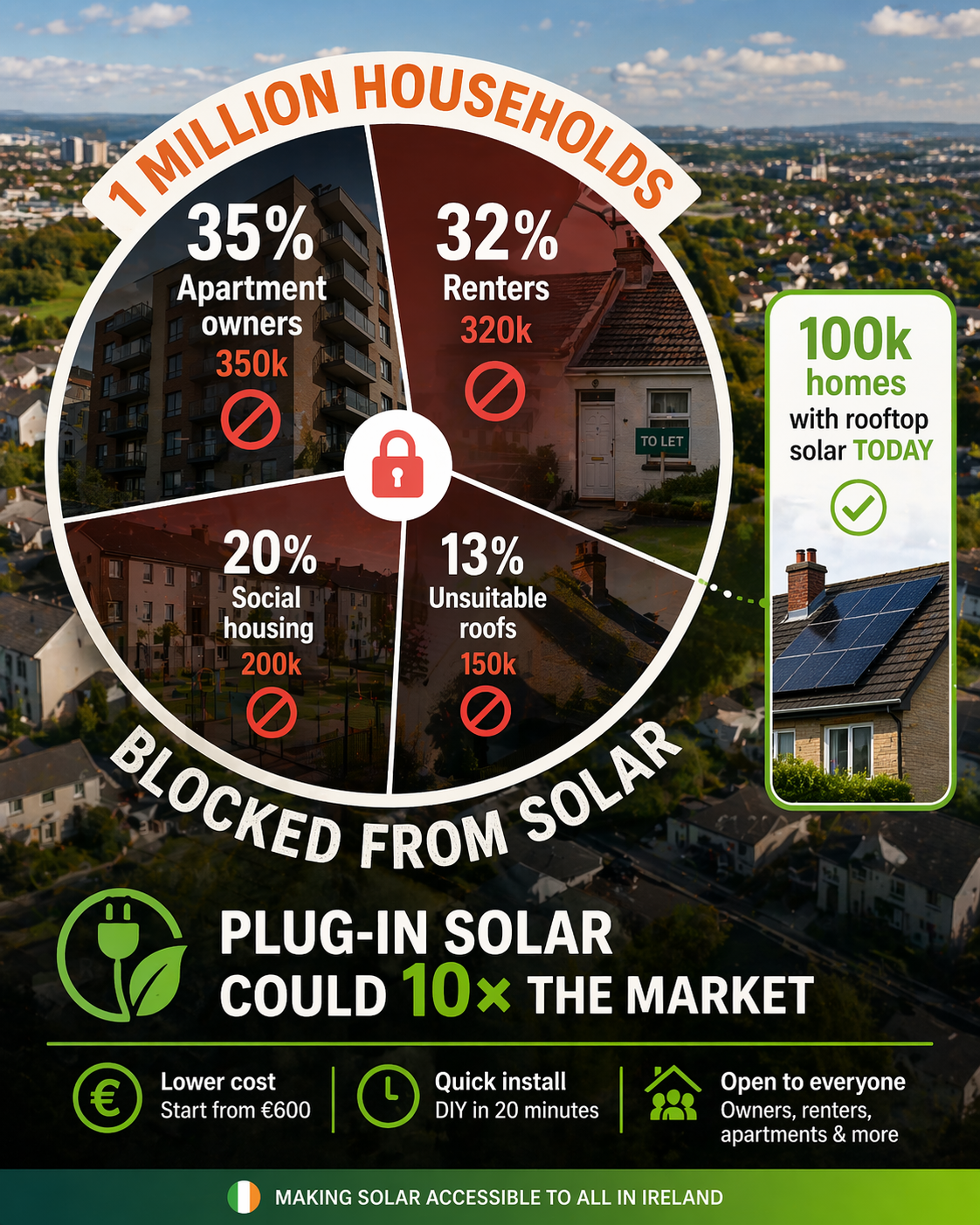
| Group | Number | Current Access to Solar |
|---|---|---|
| Apartment owners | ~350,000 units | ❌ Blocked (no roof access) |
| Renters (houses & apartments) | ~320,000 households | ❌ Blocked (need landlord permission) |
| Social housing | ~200,000 units | ❌ Blocked (council approval required) |
| Homeowners with unsuitable roofs | ~150,000 | ❌ Blocked (shading, structural issues) |
| Total potential plug-in market | ~1 million households |
For comparison, only 100,000 homes have rooftop solar today. Plug-in solar could 10× the addressable market.
Plug-In Solar vs Rooftop Solar: The Economics
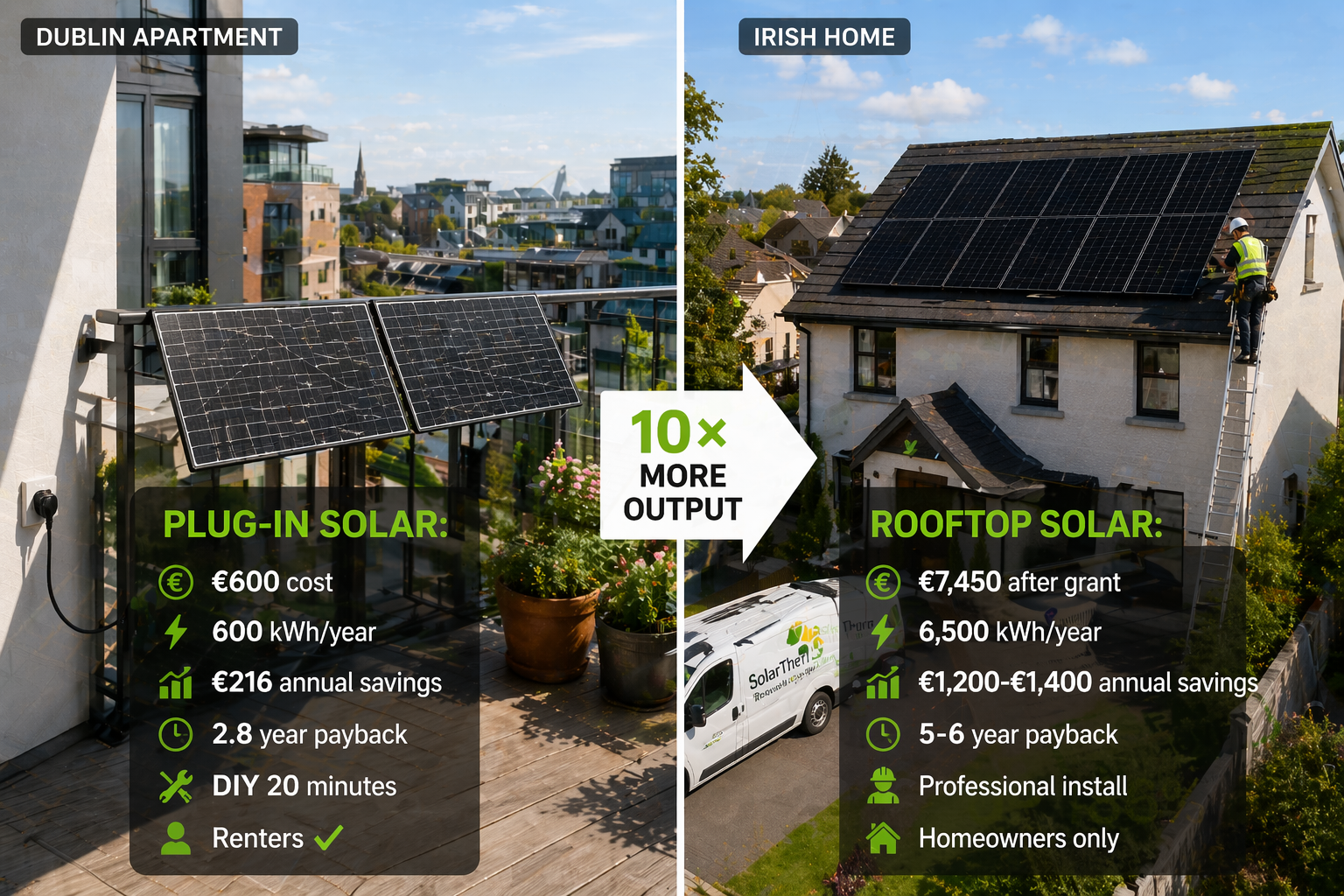
Scenario A: Plug-In Solar (800W Kit)
Upfront cost: €600 (typical German/Dutch kit)
Installation: DIY, 20 minutes
Annual generation: ~600 kWh (south-facing balcony, Dublin)
Annual savings: ~€216 (at €0.36/kWh)
Payback: 2.8 years
25-year savings: ~€5,400
Eligibility: Renters, apartment owners, anyone with a balcony or wall
Limitations:
- No SEAI grant (currently)
- Lower total output than rooftop
- Best for south/west-facing balconies
- Cannot export to grid (consumes on-site only)
Scenario B: Rooftop Solar (7 kWp Professional Install)
Upfront cost: €9,250 before grant, €7,450 after €1,800 SEAI grant
Installation: Professional, 1–2 days, requires scaffolding
Annual generation: ~6,500 kWh
Annual savings: ~€1,200–€1,400 (30–40% self-consumption + export payments)
Payback: 5–6 years
25-year savings: ~€30,000–€35,000
Eligibility: Homeowners only, suitable roof required
Advantages:
- 10× higher output
- SEAI grant available
- Export earnings (€0.13–€0.20/kWh)
- Battery-ready (add 10 kWh storage for €5–7k)
Who Should Choose What?
Choose plug-in solar if you:
- Rent or live in an apartment
- Don't have roof access or landlord permission
- Want to start small (under €1,000)
- Can't commit to a property long-term
- Have a south or west-facing balcony/wall
Choose rooftop solar if you:
- Own your home
- Have a suitable roof
- Can afford €7,450+ upfront (or finance it)
- Want maximum savings and export income
- Plan to add battery storage or EV charging
What Happens If Legalised?
If Ireland follows Germany's model, we'd likely see:
- Simplified registration — online form, no electrician required
- 800W limit — Germany caps DIY systems at 800W (2–3 panels)
- CE/TÜV certification — only approved kits allowed
- Meter compatibility — existing meters can handle up to 800W without upgrade
- No export payments — plug-in systems consume on-site only; surplus is "gifted" to grid
Market impact:
- Retailers (Woodies, B&Q, Aldi, Lidl) could stock kits
- €50–€100 million annual market (assuming 100,000 kits sold/year)
- Pressure on traditional installers to lower rooftop pricing
- Faster path to Ireland's 1 GW rooftop solar target (currently ~400 MW)
Can You Do It Now? (The Grey Area)
Technically, yes. Nothing physically stops you buying a German kit and plugging it in. Irish customs don't block solar equipment, and ESB can't detect an 800W system on your meter.
But:
- You'd be violating Safe Electric regulations
- Your home insurance might not cover fire/damage from an unregistered system
- If ESB discovers it (e.g., during a meter upgrade), they could disconnect you
- You'd have no legal recourse if something goes wrong
Our advice: Wait for legalisation. Minister O'Brien's "very open" stance and the UK's June 2026 move suggest Irish regulations could change within 3–6 months. The risk of a €2,000+ fine or insurance void isn't worth a few months of early savings.
WattCharger's Position
We support the legalisation of plug-in solar for three reasons:
- Energy democracy — solar shouldn't be a homeowner-only privilege
- Faster decarbonisation — 1 million potential plug-in homes could add 300–600 GWh/year of clean generation
- Complementary markets — plug-in solar targets renters; rooftop solar targets homeowners. Both can coexist.
For renters and apartment dwellers: Watch this space. If regulations change in 2026, WattCharger will offer certified plug-in kits with installation guides.
For homeowners: Plug-in solar won't replace rooftop economics. A €7,450 rooftop system delivers 10× more savings over 25 years (€30,000+ vs €5,400). If you own your home and have a suitable roof, rooftop solar remains the best investment.
Real-World Example: The Renter's Dilemma
Sarah, 29, rents a 2-bed apartment in Cork:
- Annual electricity bill: €840 (2,400 kWh at €0.35/kWh average)
- Balcony: south-facing, 6m²
- Landlord permission: refused rooftop solar ("too expensive, you might move")
If plug-in solar becomes legal:
- Sarah buys an 800W kit: €600
- Generates 600 kWh/year (25% of her usage)
- Saves €210/year
- Payback: 2.9 years
- If she moves, she takes the panels with her (they're portable)
Under current rules:
- Sarah has zero solar options
- Pays full grid rate forever
- Misses €5,000+ in lifetime savings
This is the inequality plug-in solar would fix.
What to Do Now
If You Rent or Live in an Apartment:
- Monitor government announcements — follow Minister O'Brien's department and the SEAI news page
- Join advocacy groups — the Green Party and Social Democrats are pushing for legalisation
- Plan your setup — measure your balcony, check orientation (south/west is best), research German kits
- Don't install yet — wait for legal clarity to protect your insurance and avoid fines
If You Own Your Home:
- Don't wait for plug-in solar — it's designed for renters, not a rooftop replacement
- Lock in the €1,800 SEAI grant — it's under pressure and could drop to €1,500 in 2027
- Act before installer backlogs grow — 10,000+ applications in Q1 2026 are pushing wait times to 3–6 months
- Get a free quote — see exactly what a rooftop system would save you
The Bottom Line
Plug-in solar isn't a perfect solution — it generates 10× less than rooftop and offers no export income. But for Ireland's 1 million renters and apartment dwellers, it's the only solution. Minister O'Brien's "very open" stance is the strongest signal yet that change is coming.
If legalised, plug-in solar would:
- Cut the average renter's electricity bill by 15–25%
- Add 300–600 GWh/year of renewable generation (equivalent to a small wind farm)
- Democratise solar access for the first time in Ireland
For homeowners, the message is clear: don't wait. Rooftop solar delivers 6× better economics than plug-in (€30,000 vs €5,000 lifetime savings) and qualifies for the €1,800 grant today.
Ready to Go Solar?
Renters: Bookmark this page and check back in Q3 2026 for plug-in kit availability.
Homeowners: Join the 100,000+ Irish homes already saving with rooftop solar. Get your free consultation and quote from WattCharger.Wwe handle everything from SEAI grant applications to installation and monitoring.
Current lead time: 4–8 weeks. Don't wait until plug-in hype pushes rooftop prices higher.
Blog Author: Rowan Egan