


On 22 April 2026, SEAI released data that confirmed what installers across Ireland already knew: the Irish home energy upgrade market is exploding.
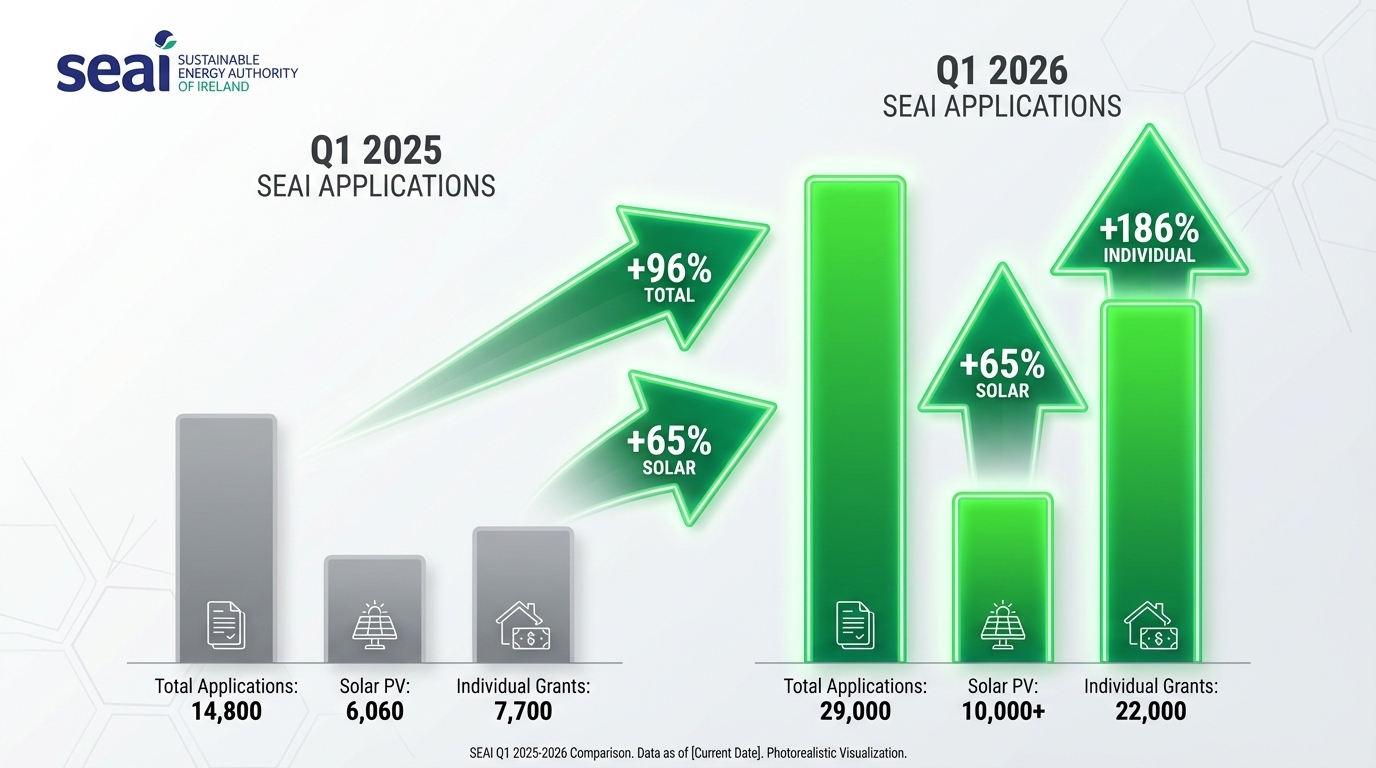
According to SEAI's official announcement, home energy upgrade applications are up 96% in Q1 2026 compared to Q1 2025. Minister Darragh O'Brien briefed Cabinet that applications for individual energy grants (not bundled One-Stop-Shop packages) are up 186% year-on-year.
The standout performer? Solar PV.
Between January and March 2026, more than 10,000 Irish households applied for the SEAI solar grant – a 65% increase on Q1 2025. This is the fastest-growing segment of Ireland's home energy transition. Solar applications now exceed attic insulation, cavity wall insulation, and heat pump applications combined.
PV Magazine put it simply in its headline on 22 April: "Solar leads Ireland's home energy upgrade grant scheme in 2026."
SEAI processed approximately 29,000 applications across all grant categories in just 90 days. Government targets 73,000 home upgrades for the full year, supported by a record €640 million Budget 2026 allocation.
But here is what the headlines miss:
This application surge is creating real capacity constraints across the Irish solar installation industry. Waiting lists are growing. Quality installers are booking 3 to 6 months out. And the 900,000 Irish homes still waiting to install solar may face longer delays and higher prices if they do not act soon.
This article breaks down what the SEAI data really means, why demand is exploding, and why acting now matters more than ever.
The Numbers: A Home Energy Revolution in Fast-Forward
SEAI Q1 2026 Data (vs Q1 2025)
| Grant Category | Q1 2026 Applications | Year-on-Year Change |
|---|---|---|
| Solar PV | 10,000+ | +65% |
| Individual grants (all categories) | ~22,000 | +186% |
| Warmer Homes scheme upgrades | 1,500+ | +40% |
| Windows and doors (new grant Feb 2026) | 7,000+ | New category |
| Attic insulation | 1,730+ | +85% |
| Total applications processed | ~29,000 | +96% |
Source: SEAI official data (22 April 2026)
The Budget 2026 Backdrop
- Record allocation: €640 million (up from €480 million in 2025)
- Annual target: 73,000 home energy upgrades
- SEAI grant maintained: €1,800 for solar PV (previously rumoured to be cut to €1,500)
- New grants introduced: Windows and doors (up to €4,000), heat pump boost (up to €12,500)
Minister O'Brien told the Dáil on 21 April:
"The almost doubling of applications so far in 2026 demonstrates that Irish households are responding to the grants. We are on track to deliver our 73,000 target, but we must ensure the installer industry can meet demand."
Why Solar Leads the Surge
Among all grant categories, solar PV outperformed everything else. Here is why Irish homeowners are choosing solar over other upgrades.
Reason 1: Fastest Payback
| Upgrade Type | Typical Cost (After Grant) | Annual Savings | Payback |
|---|---|---|---|
| Solar PV (7 kWp) | €7,450 | €1,200 – €1,400 | 5 – 6 years |
| Attic insulation | €1,000 | €250 | 4 – 5 years |
| Cavity wall insulation | €500 | €200 | 2 – 3 years |
| Heat pump | €6,500 – €10,000 | €800 – €1,200 | 8 – 10 years |
| Windows and doors | €4,000 – €10,000 | €300 – €500 | 15 – 20 years |
Attic insulation has a shorter payback, but the absolute savings are small (€250/year). Solar delivers 5 to 6 times the annual savings of insulation with comparable payback.
Reason 2: Immediate Visible Results
- Solar: Generate electricity from day one; app shows real-time output
- Insulation: Invisible results; savings appear only on quarterly bills
- Heat pump: Requires BER assessment, often insulation upgrades first
- Windows: Aesthetic and draft improvements, but long payback
Solar is the only upgrade that provides daily, measurable proof of savings. Homeowners see their electricity meter slow down (or reverse) from the moment installation is complete.
Reason 3: Protection Against Price Volatility
Since early 2026, Irish homeowners have faced:
- Share Energy 12% price increase (April 2026)
- Diesel at €2.14/litre (April 2026 – nationwide fuel protests)
- Electricity bills projected to rise €800 annually (Independent.ie, April 2026)
- Dynamic tariffs launching June 2026 (potential peak rates of €0.50 to €0.70/kWh)
Solar locks in electricity cost at €0.12/kWh for 25 years, regardless of grid price volatility. No other home upgrade provides this level of financial insurance.
Reason 4: Simplest to Install
- Solar: No planning permission required, 1 to 2-day installation, no home retrofitting
- Heat pump: Requires BER B3+ rating (often triggers €10,000+ insulation work first)
- Windows: Full replacement, disruptive, structural work
- Insulation: Varies by type (attic easiest, external wall most disruptive)
Solar is the lowest-friction home energy upgrade available. Most installations are complete before the homeowner has taken a week off work.
The Capacity Constraint: What the Numbers Don't Show
Here is the part of the SEAI story that politicians are not talking about: the Irish solar installation industry cannot keep up with demand.
The Math Problem
Demand side:
- Q1 2026 applications: 10,000+
- Projected full-year applications: 40,000+ (at current growth rate)
- Applications in the pipeline (already approved, not yet installed): ~15,000
Supply side:
- SEAI-registered solar installers in Ireland: ~400 companies
- Average installations per company: 50 to 150 per year
- Maximum industry capacity: 30,000 to 40,000 installations per year
Result: At current growth rates, demand will exceed supply capacity by late 2026.
What This Means for Homeowners
1. Longer Wait Times
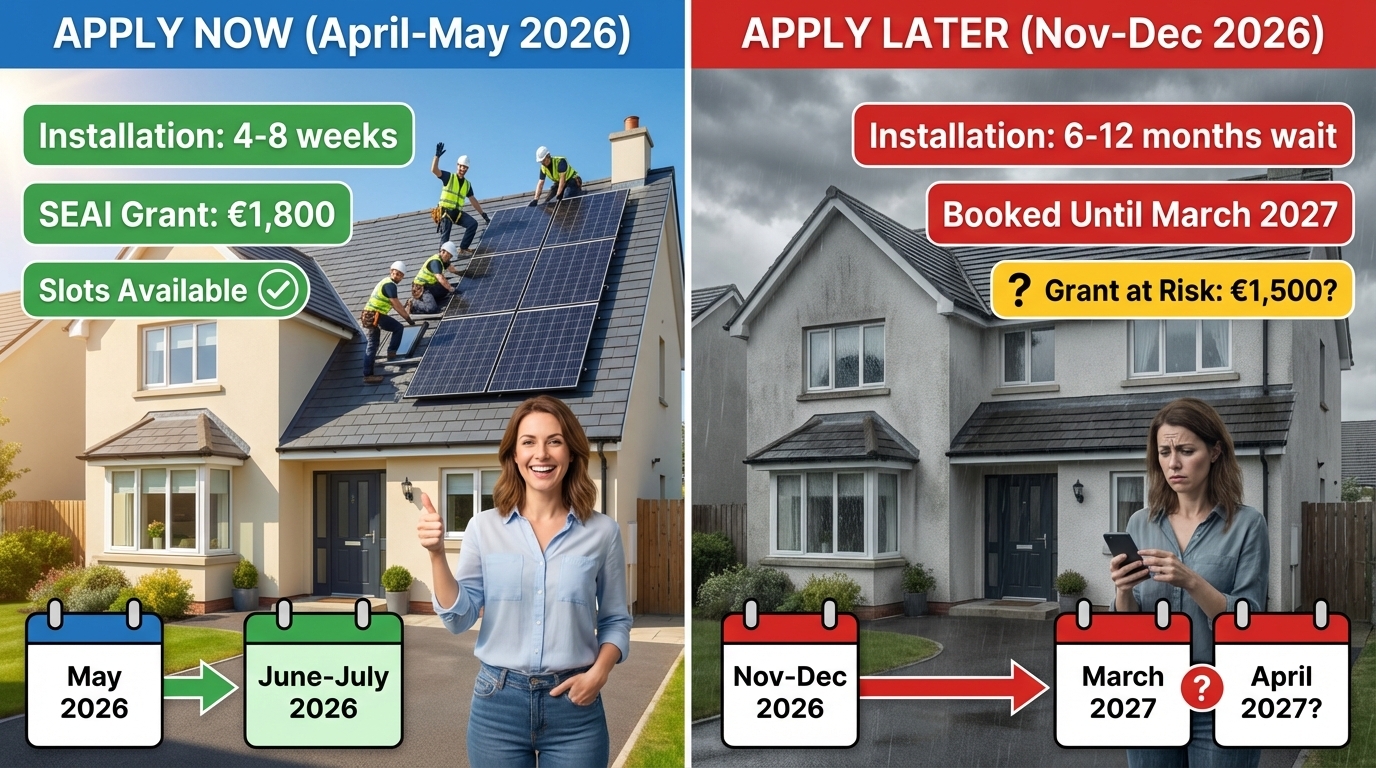
Quality installers are already booking 3 to 6 months out. By late 2026, this could extend to 6 to 12 months.
Cost of delay:
- 6-month wait: Lose €600 to €700 in foregone savings
- 12-month wait: Lose €1,200 to €1,400 in foregone savings
- Plus: Risk of grant changes, price increases, or rule updates during the wait
2. Rising Prices
When demand exceeds supply, prices rise. Expect:
- Panel prices holding steady or falling slightly (global manufacturing abundance)
- Installation costs rising 5 to 10% in 2026 due to labour constraints
- Net system costs potentially increasing €500 to €1,000 by late 2026
3. Quality Variation
High demand attracts new entrants to the solar industry, some with limited experience. Warning signs:
- Companies registered with SEAI less than 12 months
- No verifiable customer reviews or case studies
- Pressure sales tactics ("price valid today only")
- No post-installation support commitments
4. Grant Application Bottlenecks
SEAI processed 29,000 applications in Q1 2026. As volumes grow, expect:
- Longer grant approval times (currently 4 to 6 weeks, could extend to 8 to 12 weeks)
- More documentation requirements
- Tighter eligibility enforcement
The SEAI Application Process: What You Need to Know
If you are considering joining the 10,000+ homeowners who applied in Q1 2026, here is what the SEAI grant process looks like.
Step 1: Eligibility Check (5 Minutes)
To qualify for the €1,800 SEAI solar grant, you must:
- Own the property (or be applying with owner's consent)
- Be applying for a home built before 1 January 2021 (homes built after this date are ineligible)
- Have a current electricity bill with MPRN (Meter Point Reference Number)
- Intend to install a minimum 2 kWp system (approximately 4 panels)
- Use an SEAI-registered installer and SEAI-approved equipment
- Complete works within 8 months of grant approval
Apply at: seai.ie grants page
Step 2: Submit Application (15 Minutes)
Required information:
- MPRN from your electricity bill
- Property details (address, BER rating if available)
- Bank details for grant payment
- Installer quotation (obtained from SEAI-registered company)
Step 3: Grant Approval (4 to 6 Weeks Currently)
SEAI reviews your application and issues a Letter of Offer confirming:
- Grant amount (€1,800 for solar PV up to 4 kWp, scaled for larger systems)
- 8-month deadline to complete works
- Required documentation for payment claim
Step 4: Installation (1 to 2 Days)
- SEAI-certified installer completes the work
- Safe Electric certification issued
- Grid connection documentation filed (NC6 form)
Step 5: Payment Claim (2 to 4 Weeks)
After installation:
- Installer submits documentation to SEAI
- SEAI pays grant directly to homeowner (or installer, depending on arrangement)
- Net cost finalised
Total Timeline (Current Conditions)
- Application to grant approval: 4 to 6 weeks
- Grant approval to installation: 8 to 16 weeks (depending on installer availability)
- Installation to grant payment: 2 to 4 weeks
- Total: 3 to 6 months from decision to completion
Projected timeline by late 2026 (with growing demand): 5 to 10 months
Why Acting in April-May 2026 Matters
1. Lock In Current Grant Amounts
The €1,800 solar grant is confirmed for 2026 but has been reduced multiple times over the past decade:
- 2018: €3,800 (smaller systems)
- 2019: €3,000
- 2021: €2,400
- 2022–2026: €1,800
The trend is downward. Budget 2027 (announced October 2026) could reduce the grant to €1,500 or €1,200 as solar becomes "mainstream" and government focuses spending on other priorities.
Applying now locks in the current €1,800 grant amount.
2. Avoid Capacity Squeeze
With 10,000 applications in Q1 2026 alone, installer capacity will tighten throughout the year. By Q4 2026:
- Wait times potentially 6 to 12 months
- Installation prices 5 to 10% higher
- Quality installers fully booked
Applying now secures your installation slot before the backlog grows.
3. Capture Maximum Value Before Dynamic Tariffs Launch
Dynamic tariffs launch 1 June 2026. Homeowners with solar + battery installed before June can immediately capture:
- Ultra-cheap overnight rates (€0.02 to €0.05/kWh)
- Peak rate avoidance (€0.50 to €0.70/kWh)
- Export payment optimisation
Homeowners who wait may miss the first 6 to 12 months of dynamic tariff arbitrage opportunities while their application is processed.
4. Hedge Against Ongoing Price Volatility
Recent electricity price pressures include:
- Share Energy +12% (April 2026)
- Data centres consuming 32% of Ireland's electricity
- Grid pressure 2026 to 2028 (EirGrid warning)
- Expected €800 annual bill increases (Independent.ie, April 2026)
Every month of delay means another month paying grid prices you could have locked in with solar.
How WattCharger Helps You Beat the Queue
At WattCharger, we have seen the SEAI application surge first-hand. In Q1 2026, our consultation requests doubled, and our installation calendar filled 4 months in advance.
To help homeowners join the 10,000+ who applied for solar grants in Q1, we have expanded our:
Installation Capacity
- Doubled our installation teams (now serving Dublin, Cork, Galway, Limerick, and surrounding counties)
- Partnered with additional Safe Electric certified contractors to handle demand
- Current lead time: 4 to 8 weeks from consultation to installation (industry average: 3 to 6 months)
Grant Application Support
- We handle your entire SEAI application – no paperwork headaches for you
- Typical approval: 4 to 6 weeks with our support
- Grant payment processed directly upon installation completion
Transparent, Fast-Track Consultation
- Free site assessment within 7 to 14 days of your enquiry
- Detailed quotation with all costs, timelines, and financing options
- No pressure sales – our goal is helping you decide if solar is right for your home
Browse our smart EV chargers including Zappi, Ohme Home Pro, and Ohme ePod (all €300 SEAI grant approved).
Real-World Example: The Byrne Family, Kildare
Situation (February 2026):
- 4-bedroom semi-detached home
- Annual electricity cost: €1,800
- Heard about Share Energy price increase and fuel protests
- Decided to install solar
Timeline:
- 15 February 2026: Contacted WattCharger for free consultation
- 22 February 2026: Site assessment completed
- 1 March 2026: Quote accepted, SEAI application submitted by WattCharger on their behalf
- 14 April 2026: SEAI grant approved (€1,800)
- 28 April 2026: Installation completed (scheduled within 2 weeks of grant approval)
- 10 May 2026: SEAI grant paid
- Total timeline: 12 weeks from first contact to completed installation
System installed: 7 kWp solar + 10 kWh battery (€13,450 net cost)
Results (first month):
- Generated 720 kWh in May 2026
- Self-consumed 540 kWh (75% of generation)
- Monthly electricity cost: €35 (vs €150 previously)
- First-year projected savings: €1,400
The Byrne family's reaction:
"We knew solar was getting popular, but we didn't realise installer capacity would tighten so quickly. When we called WattCharger in February, they could install within 8 weeks. When our neighbour tried in April, the wait was 4 to 6 months. We feel lucky we acted when we did."
FAQs: Joining the 10,000+
"Is €1,800 the maximum grant I can get?"
For solar PV only, yes. The €1,800 grant applies to systems from 2 kWp upwards.
However, you can combine grants:
- Solar PV: €1,800
- Attic insulation: up to €1,600
- Cavity wall insulation: up to €2,700
- Windows and doors: up to €4,000
- Heat pump: up to €12,500
Maximum combined grants: ~€22,600 (if you qualify for all categories through a One-Stop-Shop application).
"What if I apply and the grant runs out before I'm installed?"
The SEAI allocates €640 million for 2026 across all grant categories. If fully committed, new applications may face delays or reduced amounts.
The safest path: Apply as early as possible. Approved applications are honoured even if the scheme pauses for new applicants later.
"Can I install solar without the SEAI grant?"
Yes, but you lose the €1,800 grant plus 0% VAT benefit. A 7 kWp system without grant costs €9,250 (vs €7,450 with grant). Payback extends from 5-6 years to 7-8 years without the grant.
"How long will my application take in April 2026?"
With WattCharger handling your application:
- Application to grant approval: 4 to 6 weeks
- Grant approval to installation: 4 to 8 weeks
- Installation to grant payment: 2 to 4 weeks
- Total: 10 to 18 weeks
Industry average (non-WattCharger): 3 to 6 months (growing toward 6 to 12 months by late 2026)
"Should I wait for the Social Democrats' 'Solar for All' plan?"
No. The Social Democrats' proposal to double the solar grant to €3,600 is a political position, not legislation. The governing Fianna Fáil/Fine Gael coalition has not committed to grant increases.
Waiting costs:
- 6-month wait: Lose €600-€700 in savings
- 12-month wait: Lose €1,200-€1,400 in savings
- Risk of grant reduction (more likely than increase given historical trend)
Apply now. If grants increase later, you will still benefit from the longer period of electricity savings.
Final Thoughts
On 22 April 2026, SEAI confirmed what installers across Ireland already knew: Irish homeowners are embracing solar at unprecedented rates.
- Applications up 96% (overall home energy upgrades)
- Solar PV applications up 65% (over 10,000 in Q1 alone)
- Individual grant applications up 186% (fastest growth category)
The "rooftop revolution" is not a marketing slogan. It is backed by hard data: 29,000 applications processed in 90 days, €640 million allocated for 73,000 upgrades, and a clear government commitment to maintaining the €1,800 solar grant through 2026.
But here is the reality most homeowners miss: capacity is tightening. Wait times are growing. Quality installers are booking 3 to 6 months in advance. And by late 2026, joining the 10,000+ who applied in Q1 may mean waiting 6 to 12 months for installation.
The time to act is now.
You do not need to wait for:
- Better grants (current €1,800 is already strong; trend is downward)
- Political action (Social Democrats' "Solar for All" has no binding support)
- Perfect weather (Irish solar works year-round)
- More data (10,000 Q1 applications is all the social proof you need)
The 10,000 Irish homeowners who applied in Q1 2026 are already locked in. The question is whether you will join them, or wait another year while electricity prices rise and installer capacity tightens.
Ready to Join the Rooftop Revolution?
Over 10,000 Irish homeowners applied for SEAI solar grants in the first three months of 2026 alone. Join them before installer waiting lists grow further. Get in touch with WattCharger for a free consultation and fast-track installation. We handle the full SEAI application process and offer one of the shortest installation lead times in Ireland.
Applications are up 186%. Installer capacity is tightening. The €1,800 grant could be cut in Budget 2027. Act now.
Blog Author: Rowan Egan