


Share Energy Raises Prices 12% from April 2026: Here's How to Lock in €0.12/kWh for 25 Years
Just when Irish households thought electricity prices had stabilised, the increases are back.
Share Energy has announced a 12 per cent electricity price increase effective 1 April 2026, raising unit rates and adding approximately €213 per year to the average customer's bill. This follows similar moves by Click Energy (9.5 per cent increase) and comes as wholesale electricity prices remain stubbornly elevated at €122.07 per MWh year-to-date in 2026, compared to €113.83 per MWh in 2025.
For Irish homeowners, the message is clear: grid electricity prices are volatile, unpredictable, and trending upward over the long term. Even when prices temporarily stabilise, suppliers eventually pass through higher costs from carbon taxes (now €71 per tonne CO₂), grid upgrade charges (adding €1.75 per month from October 2025), and wholesale market fluctuations.
But here is the part most people miss: you do not have to accept this price volatility.
Solar panels allow you to lock in your electricity generation cost at approximately €0.12 per kWh (effective cost over 25 years) regardless of what happens to grid prices. While Share Energy customers will pay more from April 2026, solar panel owners will continue generating electricity at the same fixed cost they locked in years ago.
This is not just about renewable energy. It is about financial protection against decades of future price increases.
The Share Energy Price Increase: What You Need to Know
The Numbers
Effective 1 April 2026, Share Energy electricity rates will increase:
- Unit rate: Rising from 25.29p to 31.96p per kWh (including VAT) – a 26.4% increase for Share Energy customers
- Average customer impact: Approximately £213 per year (roughly €250) added to annual bills
- Context: This is Share Energy's first price increase since they entered the market, but follows a pattern of renewed price pressure across Irish suppliers
At the time of writing, Share Energy operates primarily in Northern Ireland, but the broader trend affects suppliers across the island. According to PowerToSwitch's analysis of the Share Energy increase, the rate change will see typical customers pay around £213 more per year from 1 April 2026
Why Prices Are Rising Again
Four factors are driving the latest round of electricity price increases:
- Wholesale prices remain elevated – According to Kilowatt.ie's wholesale price tracker, Irish wholesale electricity averaged €122.07 per MWh year-to-date in 2026, compared to €113.83 per MWh in 2025. Monthly peaks in March 2026 reached €138.29 per MWh. While prices dropped from the 2022 crisis peak (€600+ per MWh), they have stabilised at roughly 70 to 80 per cent above pre-2021 levels.
- Grid upgrade costs – ESB Networks and EirGrid are spending €18.9 billion upgrading Ireland's electricity grid through 2030. These costs are passed to consumers via network charges, adding €1.75 per month to household bills from October 2025.
- Carbon tax increases – Ireland's carbon tax rose to €71 per tonne CO₂ in Budget 2026 and is legislated to reach €100 per tonne by 2030. This indirectly increases electricity costs as fossil fuel generation becomes more expensive.
- Data centre demand – Data centres now consume 32 per cent of Ireland's electricity, creating sustained pressure on grid capacity and wholesale prices during peak demand periods.
The result: Electricity prices may fluctuate month to month, but the long-term trend is upward. Homeowners relying entirely on grid electricity are exposed to these forces indefinitely.
The Historical Pattern: Prices Always Rise Eventually
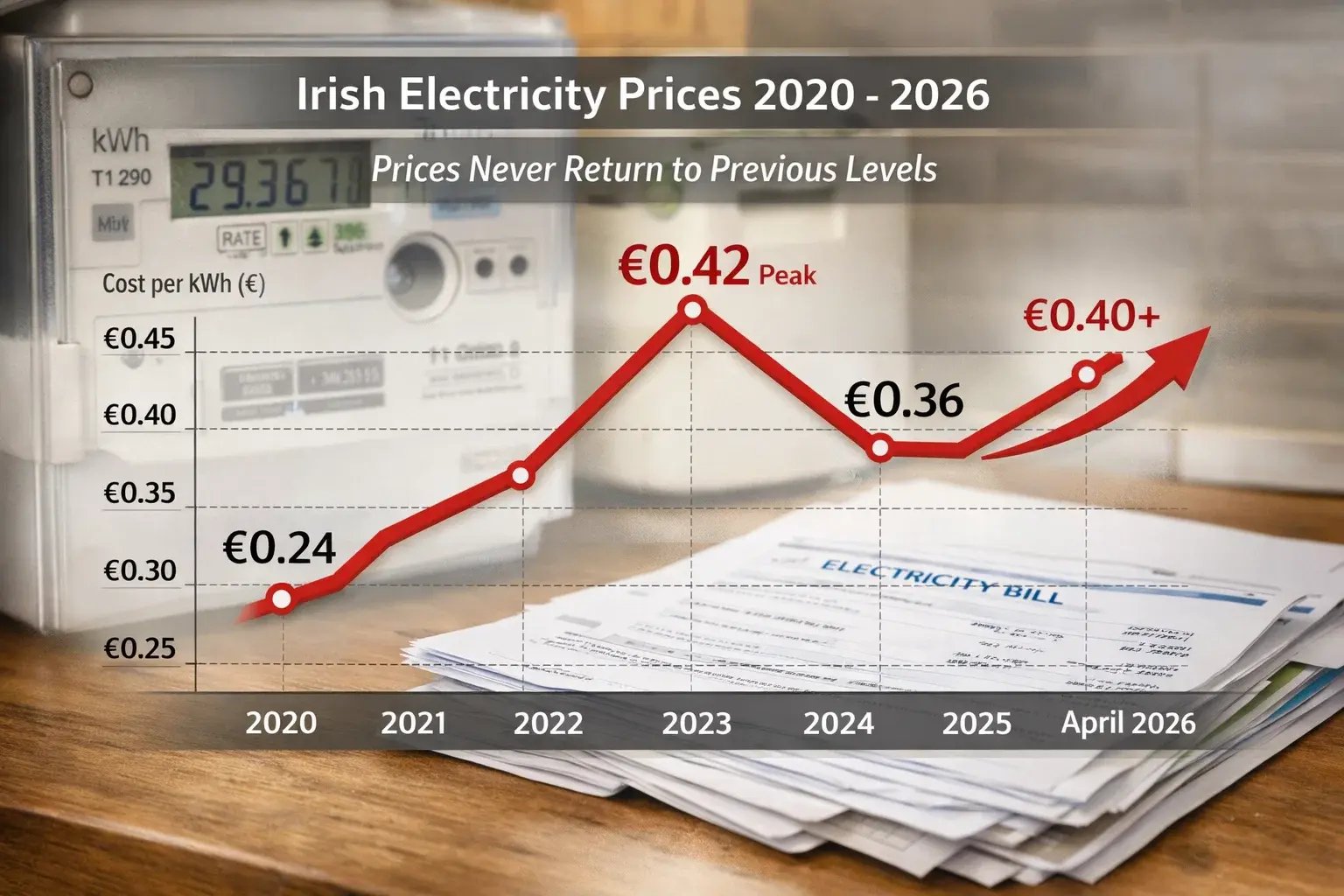
Let's look at the track record of Irish electricity prices over the past decade:
| Period | Average Residential Rate (€/kWh) | Notes |
|---|---|---|
| 2020 | €0.24 | Pre-crisis baseline |
| 2021 | €0.26 | Modest increase |
| 2022 | €0.38 | Energy crisis begins |
| 2023 (peak) | €0.42 | Crisis peak, government supports active |
| 2024 | €0.38 | Slight decline as wholesale prices ease |
| 2025 | €0.36 | Brief plateau |
| April 2026 | €0.40+ (projected) | Increases resume (Share Energy, Click Energy) |
At the time of writing, Irish electricity prices remain approximately 70 to 80 per cent higher than they were in 2020. Even after the energy crisis subsided, prices never returned to pre-crisis levels.
Historical trends show:
- Prices rose steadily from the mid-1990s to 2007
- Brief plateau during the 2008–2012 recession
- Renewed increases from 2013 onwards
- Dramatic spike 2022–2023 (energy crisis)
- Stabilisation 2024–2025, but at elevated levels
- Increases resuming in 2026
The lesson: Electricity prices may pause, but they never fall back to historical levels and always resume climbing over time.
Solar Panels: Locking in €0.12/kWh for 25 Years
Here is the alternative model: generate your own electricity at a fixed cost.
How Solar Panel Costs Work
When you install a 7 kWp solar panel system, you pay an upfront cost (approximately €7,450 after the €1,800 SEAI grant). That system then generates electricity for 25+ years with virtually no additional costs beyond occasional cleaning and monitoring.
The lifetime cost calculation:
- System cost: €7,450 (after grant)
- Annual generation: 6,500 kWh per year (typical for 7 kWp system in Ireland)
- System lifespan: 25 years (panels typically have 25-year performance warranties)
- Total electricity generated: 6,500 kWh/year × 25 years = 162,500 kWh
- Cost per kWh generated: €7,450 ÷ 162,500 kWh = €0.046 per kWh
But you still need the grid for times when solar is not generating (nighttime, winter evenings). You pay grid network charges (approximately €0.076 per kWh in 2026) even when using your own solar electricity.
Effective total cost per kWh:
- Solar generation cost: €0.046/kWh
- Grid infrastructure cost (when you use solar): €0.076/kWh
- Total effective cost: €0.12 per kWh
This cost is locked in for 25 years. It does not matter if grid electricity rises to €0.50/kWh, €0.60/kWh, or €1.00/kWh over the next two decades. Your solar generation cost remains fixed.
The Power of Price Protection
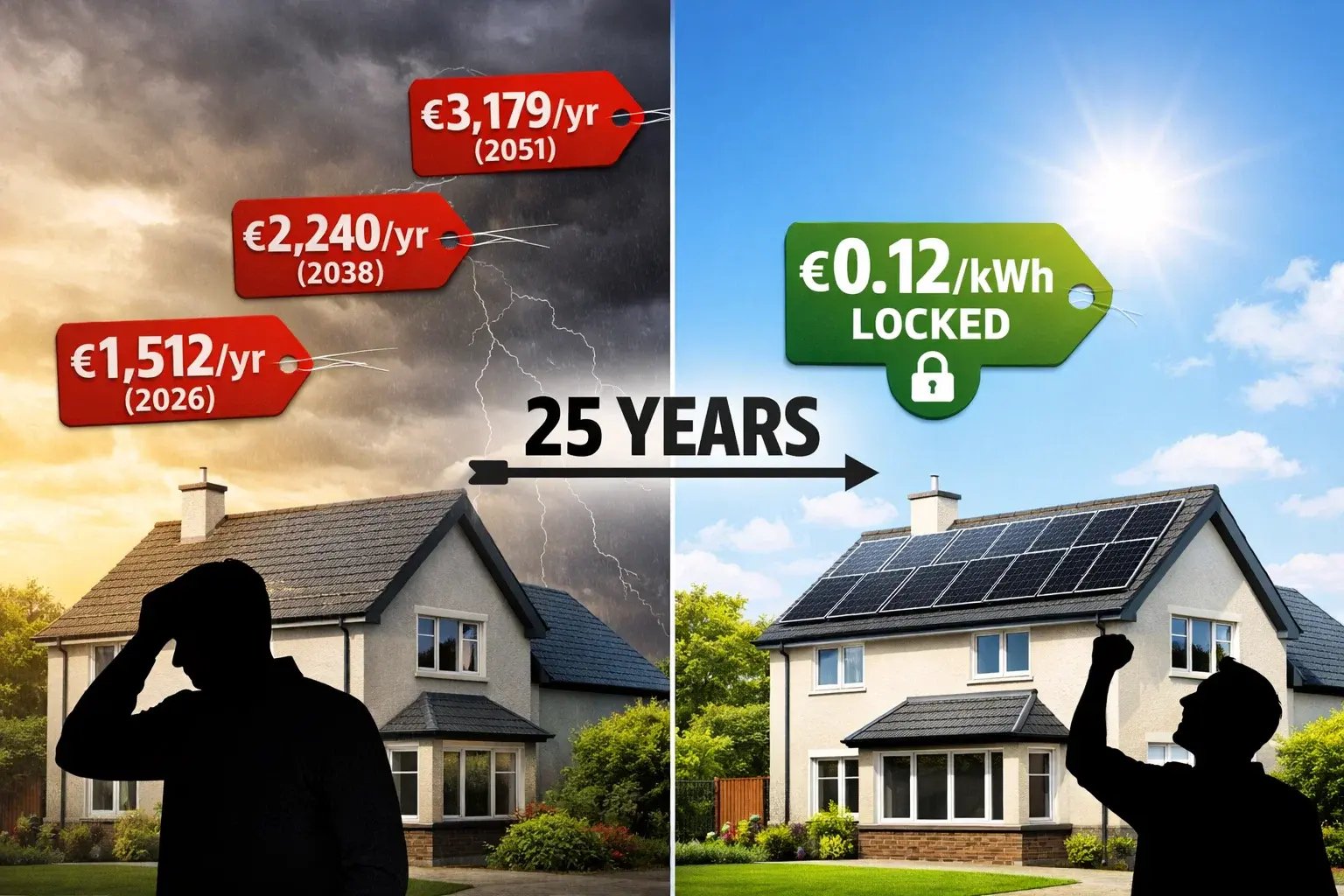
Let's compare two households over 25 years:
Household A: Grid-Only (No Solar)
- 2026 electricity rate: €0.36/kWh
- Annual consumption: 4,200 kWh
- 2026 annual cost: €1,512
Assuming 3% annual price inflation (conservative based on historical trends):
- 2031 cost: €1,754/year
- 2036 cost: €2,036/year
- 2041 cost: €2,362/year
- 2046 cost: €2,740/year
- 2051 cost: €3,179/year
Total cost over 25 years: €51,830
Household B: 7 kWp Solar + Grid Backup
- 2026 solar investment: €7,450
- Annual solar generation: 6,500 kWh
- Self-consumption: 30–40% (without battery) = 2,600 kWh
- Grid electricity purchased: 1,600 kWh/year
- Solar electricity cost: €0.12/kWh (locked in)
- Grid electricity cost: €0.36/kWh in 2026 (rising 3%/year)
Year 1 (2026):
- Solar cost: 2,600 kWh × €0.12 = €312
- Grid cost: 1,600 kWh × €0.36 = €576
- Total: €888/year (saves €624 vs grid-only)
By 2051 (Year 25):
- Solar cost: 2,600 kWh × €0.12 = €312 (unchanged)
- Grid cost: 1,600 kWh × €1.21 = €1,936 (grid price tripled)
- Total: €2,248/year
Total cost over 25 years: €7,450 (upfront) + €32,000 (grid purchases over 25 years) = €39,450
Total savings vs grid-only: €51,830 – €39,450 = €12,380
And this assumes only 3 per cent annual price inflation. If grid prices rise faster (as they did 2021–2023), the savings increase dramatically.
Add a Battery: Lock in 70–80% Energy Independence
If you add a 10 kWh home battery (approximately €5,000 to €7,000), you can raise self-consumption from 30–40 per cent to 70–80 per cent.
Battery economics:
- System cost: €7,450 (solar) + €6,000 (battery) = €13,450
- Annual solar self-consumption: 70% of 4,200 kWh = 2,940 kWh
- Grid electricity purchased: 1,260 kWh/year
Year 1 (2026):
- Solar cost: 2,940 kWh × €0.12 = €353
- Grid cost: 1,260 kWh × €0.36 = €454
- Total: €807/year (saves €705 vs grid-only)
Total cost over 25 years: €13,450 (upfront) + €25,000 (grid purchases over 25 years) = €38,450
Total savings vs grid-only: €51,830 – €38,450 = €13,380
The battery adds approximately €1,000 in extra lifetime savings while providing energy independence, backup power (on some systems), and readiness for dynamic tariffs launching in June 2026.
Dynamic Tariffs: Solar + Battery Becomes Even More Valuable
From 1 June 2026, Irish electricity suppliers will offer dynamic tariffs where prices change every 30 minutes based on wholesale electricity costs.
What this means:
- Off-peak overnight rates could drop to €0.02 to €0.08 per kWh
- Peak evening rates could spike to €0.50 to €0.70 per kWh
With a solar + battery system:
- Charge battery during ultra-cheap overnight periods (€0.05/kWh)
- Use battery during expensive peak periods (avoiding €0.50+/kWh)
- Use solar during the day (free generation)
- Export excess solar at high prices if dynamic export tariffs launch
The combination of locked-in solar generation cost (€0.046/kWh) and strategic battery use on dynamic tariffs could reduce your effective electricity cost to under €0.10 per kWh even as grid-only households pay €0.40 to €0.50 per kWh average.
Solar + battery is not just price protection. It is a financial arbitrage opportunity.
Real-World Example: The O'Connor Family, Dublin
Situation (March 2026):
- 4-bedroom semi-detached home
- Annual electricity consumption: 4,500 kWh
- Current supplier: standard tariff, €0.36/kWh
- Annual electricity cost: €1,620
- Frustrated by Share Energy and Click Energy price increase announcements
Action taken (April 2026):
- Installed 7 kWp solar system (€7,450 after grant)
- Installed 10 kWh battery (€6,000)
- Total investment: €13,450
- Switched to Pinergy night-rate tariff (€0.0545/kWh from 2am to 5am)
Results (Year 1):
- Solar generation: 6,500 kWh/year
- Self-consumption with battery: 75% of 4,500 kWh = 3,375 kWh
- Grid electricity purchased (mostly night-rate): 1,125 kWh × €0.08/kWh = €90
- Solar + battery effective cost: 3,375 kWh × €0.12/kWh = €405
- Total annual cost: €495 (down from €1,620)
- Annual savings: €1,125
- Payback period: 12 years
By 2051 (25 years later):
- Solar cost: still €0.12/kWh (locked in)
- Grid night-rate cost: risen to €0.24/kWh (tripled from €0.08)
- Annual electricity cost: €675 (vs €3,179 for grid-only households by 2051)
- Total 25-year savings: €51,830 (grid-only) – €38,450 (solar+battery) = €13,380
The O'Connor family's reaction: "We kicked ourselves for not doing this five years ago. The Share Energy price increase was the wake-up call. Now we are completely insulated from future price rises. Our only regret is waiting so long."
Why Solar Is a Financial Hedge, Not Just an Environmental Choice
Most people think of solar panels as "green energy" or "saving the planet." Those things are true, but they miss the most powerful benefit: solar is financial insurance against electricity price volatility.
Think of it this way:
- Insurance policy: You pay a premium (€7,450 for solar) to protect against a future risk (rising electricity prices)
- Return on investment: Unlike car insurance or home insurance, solar also delivers guaranteed returns (€1,200+/year in savings)
- 25-year protection: Your €7,450 premium protects you for 25+ years, not just one year
- No claims: Unlike insurance, you benefit immediately whether prices rise or not (you save money from day one)
If you believe Irish electricity prices will be higher in 2030, 2035, and 2040 than they are today (and all historical evidence says they will be), then solar panels are the single best financial hedge available to Irish homeowners.
How WattCharger Can Help You Lock in Your Electricity Costs
WattCharger specialises in helping Irish homeowners achieve energy independence and price protection through solar PV systems, battery storage, and smart EV chargers.
Our Solar + Battery Packages
Solar Only (Price Protection Starts Here):
- 5 kWp system (10 panels): ~€6,000 after grant, generates 4,700 kWh/year, €0.11/kWh effective cost
- 7 kWp system (14 panels): ~€7,450 after grant, generates 6,500 kWh/year, €0.12/kWh effective cost
- 9 kWp system (18 panels): ~€8,900 after grant, generates 8,000 kWh/year, €0.13/kWh effective cost
Solar + Battery (Maximum Price Protection):
- 7 kWp solar + 10 kWh battery: ~€13,500 after grant, 70–80% energy independence
- 9 kWp solar + 10 kWh battery: ~€15,000 after grant, 80–90% energy independence
All systems include:
- Premium solar panels (25-year performance warranty guaranteeing your locked-in cost)
- Hybrid inverter (battery-ready for future expansion)
- Full installation by SEAI-registered, Safe Electric-certified installers
- SEAI grant application handled on your behalf (€1,800 for solar)
- Monitoring app to track generation, self-consumption, and lifetime savings
Our Honest Assessment
When you contact WattCharger for a free consultation, we will:
- Calculate your current exposure to grid price increases – How much are you spending now, and how much will you spend over 25 years if prices keep rising?
- Show your locked-in cost with solar – Exact cost per kWh over 25 years based on your roof orientation and system size
- Model different price scenarios – What happens if grid prices rise 2%/year, 3%/year, or 5%/year? How much do you save in each scenario?
- Explain battery ROI – Does adding a battery make financial sense for your usage pattern and budget?
- Handle all paperwork – SEAI grants, Safe Electric certification, supplier notifications
We will tell you if solar is not a good fit for your home. Our goal is to help you lock in your electricity costs, not to sell you technology you do not need.
Final Thoughts
Share Energy's 12 per cent price increase is not an anomaly. It is a reminder that grid electricity prices are fundamentally volatile and subject to forces beyond your control: wholesale markets, carbon taxes, grid upgrade costs, and geopolitical shocks.
You cannot stop suppliers from raising prices. But you can opt out of the price volatility game entirely.
Solar panels lock in your electricity generation cost at approximately €0.12 per kWh for 25 years, regardless of what happens to grid prices. Whether Share Energy raises prices another 10 per cent next year, or 20 per cent, or 50 per cent, your solar generation cost remains frozen at the rate you locked in today.
This is not about predicting the future. It is about protecting yourself from it.
The 94,000+ Irish homeowners who have already installed solar did not do it because they could predict the Share Energy price increase. They did it because they recognised that price certainty is worth more than price speculation.
While Share Energy customers will pay an extra €213 per year from 1 April 2026, solar panel owners will continue generating electricity at the same fixed cost they locked in years ago. And they will keep that advantage for the next 25 years.
The question is not whether you should lock in your electricity costs. It is whether you want to do it before or after the next round of price increases.
Ready to Lock in Your Electricity Costs?
Stop paying for grid price volatility. Join thousands of Irish homeowners who have locked in their electricity costs with solar panels and battery storage. Get in touch with WattCharger for a free consultation and personalised price protection plan. We handle everything from system design to SEAI grant paperwork, so you can lock in your electricity costs with confidence.
Your future electricity bills should not be a mystery. Make them predictable.
Blog Author: Rowan Egan