


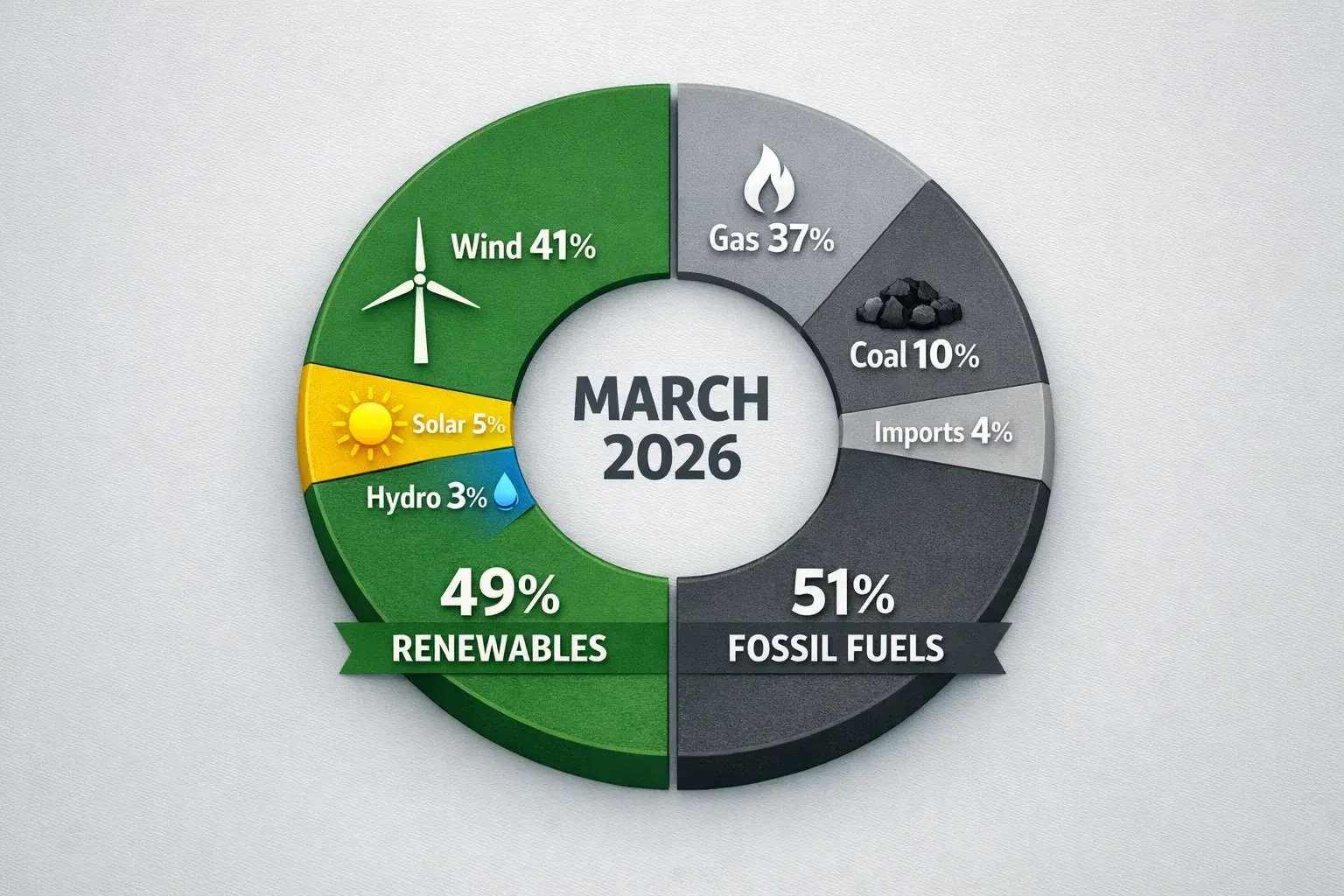
On 13 April 2026, EirGrid released provisional data that made headlines across Irish media: 49% of Ireland's electricity came from renewable sources in March 2026.
Wind farms delivered 41% of the country's electricity (1,537 GWh), overtaking gas-fired generation for the first time. Solar hit a new instantaneous peak of 983 MW on 21 March, coming within 17 MW of the symbolic 1 gigawatt threshold.
Ireland is approaching 50% renewable electricity – a psychological and practical milestone that validates the country's €18.9 billion grid investment and demonstrates that solar, wind, and battery storage work at scale.
But here is the question many homeowners are asking:
"If Ireland already gets 49% of electricity from renewables, is it still worth installing solar panels on my roof? Haven't we already 'solved' the problem?"
The answer is: Solar + battery is MORE valuable now, not less.
High renewable penetration on the national grid creates volatility, curtailment risks, and export payment compression – all of which increase the value of self-consumption and battery storage at the household level.
This article explains what 49% renewable electricity really means, why it changes the economics of rooftop solar, and why battery storage has become the critical piece of the puzzle for Irish homeowners in 2026.
What "49% Renewable" Actually Means
The Breakdown (March 2026)
According to EirGrid's provisional data:
| Energy Source | Share of Total Generation | Monthly Output |
|---|---|---|
| Wind (onshore) | 41% | 1,537 GWh |
| Solar (grid-scale + rooftop) | ~5% | ~190 GWh |
| Hydro | ~3% | ~110 GWh |
| Total Renewables | 49% | ~1,837 GWh |
| Gas | 37% | ~1,390 GWh |
| Coal | 10% | ~375 GWh |
| Interconnectors (imports) | 4% | ~150 GWh |
| Total Fossil Fuels | 51% | ~1,915 GWh |
Key milestones:
- Wind: First time wind exceeded 40% of monthly generation
- Solar: New peak of 983.46 MW on 21 March (first time breaking 980 MW)
- Total renewables: Approaching 50% threshold (49% is provisional; final figure may reach 50%)
What This Does NOT Mean
It does NOT mean:
- Ireland gets 49% renewable electricity all the time (it is a monthly average)
- Your home is powered by 49% renewables right now (actual mix varies minute by minute)
- The grid is "saturated" with renewables and cannot handle more solar
- Rooftop solar is less valuable because the grid is already "green enough"
What it DOES mean:
- Ireland's renewable capacity is growing fast (8 GW installed, up from 5.5 GW in 2023)
- The grid is becoming more variable (high renewables during windy/sunny periods, low during calm/dark periods)
- The value of self-consumption is increasing (because grid electricity is increasingly volatile in both price and carbon intensity)
- Battery storage is becoming essential for capturing value from renewables
Why High Grid Renewables = Higher Battery Value
Here is the counterintuitive economics: As the national grid becomes more renewable, battery storage at your home becomes MORE valuable, not less.
Reason 1: Export Payments Are Compressing
When solar and wind flood the grid during sunny, windy midday periods, wholesale electricity prices drop or even go negative (generators pay to offload excess power).
Current export payment landscape (April 2026):
- Clean Export Guarantee (CEG): €0.13 to €0.20/kWh (voluntary scheme from suppliers)
- Wholesale midday prices (high solar/wind days): €0.02 to €0.08/kWh
- Risk: As more solar comes online, midday export payments will compress toward wholesale levels
Example:
- 2024: Export payments averaged €0.18/kWh (suppliers paid premium over wholesale to attract solar customers)
- 2026: Export payments now €0.13 to €0.15/kWh (suppliers reducing rates as solar adoption grows)
- 2028 projection: Export payments could drop to €0.10 to €0.12/kWh if 500,000 homes have solar
Why this matters:
If you export 5,000 kWh/year of excess solar at:
- €0.18/kWh (2024 rate): Earn €900/year
- €0.13/kWh (2026 rate): Earn €650/year (–€250)
- €0.10/kWh (2028 projection): Earn €500/year (–€400 vs 2024)
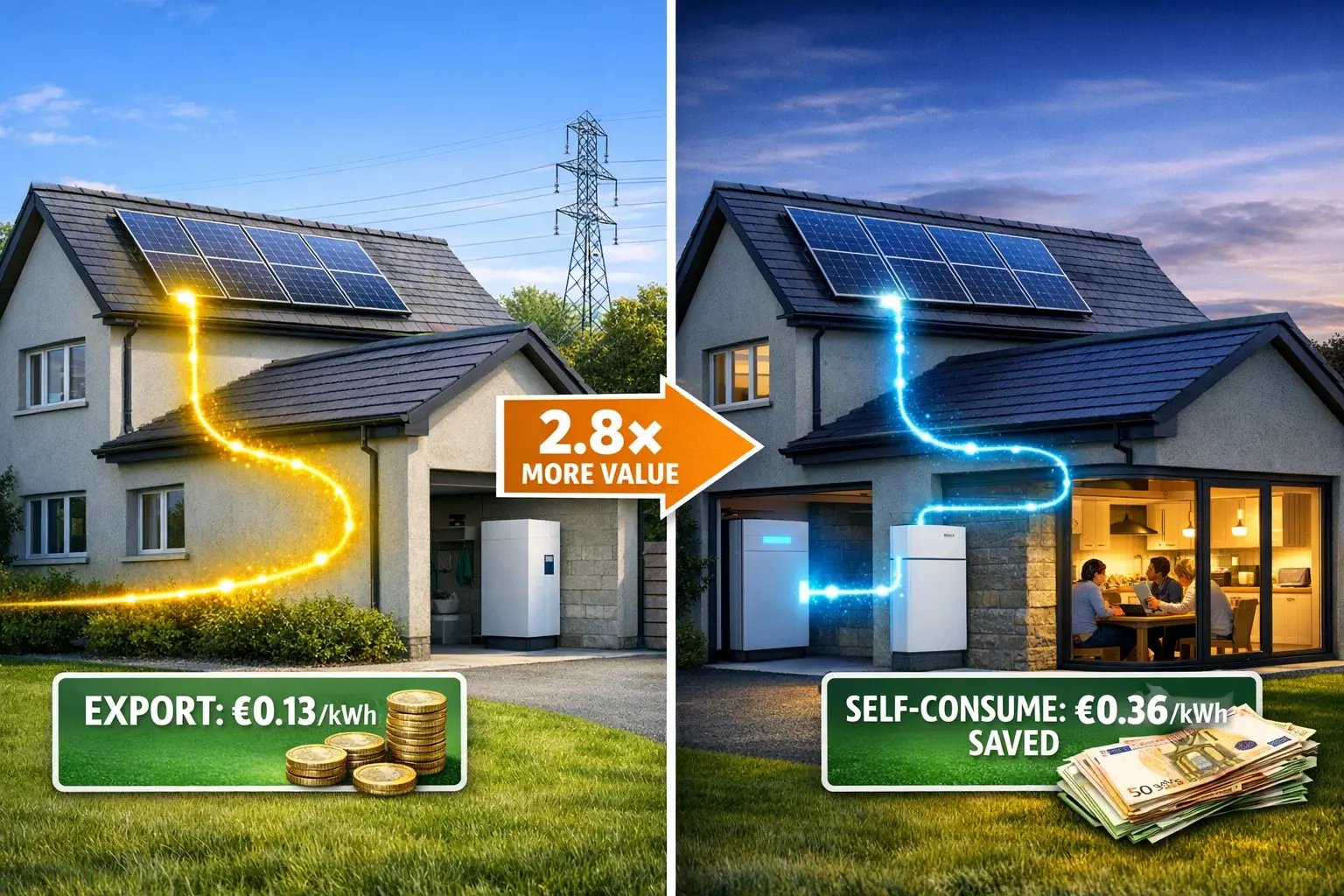
The solution: Battery storage lets you store midday solar and use it during evening peak hours (6pm to 9pm) when you would otherwise pay €0.36 to €0.42/kWh from the grid.
Value comparison:
- Export at €0.13/kWh: Earn €0.13 per kWh
- Self-consume from battery at evening peak: Save €0.36/kWh (value = €0.36 per kWh)
Battery storage delivers 2.8× more value per kWh than exporting.
Read more about solar export payments in Ireland.
Reason 2: Grid Volatility Increases
When wind and solar account for 49% of generation, the grid experiences higher volatility:
Windy, sunny day (21 March 2026):
- Wind: 2,500 MW
- Solar: 983 MW
- Total renewables: ~3,500 MW (70%+ of demand at midday)
- Gas generation: curtailed to minimum levels
- Wholesale price: €0.05/kWh
Calm, cloudy evening (typical winter weekday):
- Wind: 300 MW
- Solar: 0 MW (dark)
- Total renewables: ~300 MW (10% of demand)
- Gas generation: ramped to maximum
- Wholesale price: €0.45/kWh
The problem: Your home electricity demand does not align with renewable generation.
Peak demand hours (6pm to 9pm):
- Low renewable generation (solar = zero, wind often low)
- High grid prices (€0.36 to €0.50/kWh)
- High carbon intensity (gas-fired generation)
Peak solar generation hours (11am to 3pm):
- High renewable generation (solar peak, often high wind)
- Low grid prices (€0.05 to €0.15/kWh)
- Low demand at home (most people at work/school)
Battery storage solves the mismatch:
- Charge battery from solar 11am to 3pm (free electricity)
- Discharge battery 6pm to 9pm (avoid paying €0.36 to €0.50/kWh from grid)
- Result: 70 to 80% energy independence vs 30 to 40% without battery
Learn more about choosing the right battery size for your home.
Reason 3: Dynamic Tariffs Launch June 2026
From 1 June 2026, all Irish electricity suppliers must offer at least one dynamic tariff where prices change every 30 minutes based on wholesale electricity costs.
Expected price ranges:
- Off-peak (2am to 5am, high wind/solar days): €0.02 to €0.08/kWh
- Standard (midday, moderate demand): €0.15 to €0.25/kWh
- Peak (6pm to 9pm, low renewables): €0.50 to €0.70/kWh
Without battery:
You pay peak rates (€0.50 to €0.70/kWh) during evening when your demand is highest.
With battery:
- Charge battery overnight at €0.02 to €0.05/kWh (ultra-cheap off-peak)
- Charge battery from solar 11am to 3pm (free)
- Discharge battery 6pm to 9pm (avoid €0.50 to €0.70/kWh peak)
- Effective electricity cost: €0.10 to €0.15/kWh average
The higher the grid renewable penetration, the wider the price spread between off-peak and peak – and the more valuable battery arbitrage becomes.
Reason 4: Grid Pressure Continues 2026–2028
While 49% renewable electricity is a milestone, Ireland's grid faces capacity pressure from 2026 to 2028 due to:
- Data centres: Now consuming 32% of Ireland's electricity
- EV adoption: 14,004 new EVs registered in Q1 2026 (up 40.5% year-on-year), adding demand during evening charging hours
- Heat pump rollout: Government target of 400,000 heat pumps by 2030 (currently 14,194 installed)
EirGrid's February 2026 warning:
"There is a potentially challenging situation for the electricity system between 2026 and 2028, as rising demand risks outstripping supply during peak winter evenings."
Solar + battery reduces your grid dependence during those critical pressure periods, protecting you from:
- Potential blackouts or brownouts
- Price spikes during supply constraints
- Competition with data centres for grid capacity
The Solar + Battery Value Proposition (2026 Economics)
Let's compare three scenarios for a typical Irish home (4,200 kWh annual consumption):
Scenario A: Grid-Only (No Solar)
Annual cost (2026):
- 4,200 kWh × €0.36/kWh = €1,512/year
With dynamic tariffs (June 2026+):
- Off-peak usage (20%): 840 kWh × €0.05/kWh = €42
- Standard usage (40%): 1,680 kWh × €0.22/kWh = €370
- Peak usage (40%): 1,680 kWh × €0.55/kWh = €924
- Total: €1,336/year (€176 savings if you manually shift usage, which most people cannot do)
Scenario B: Solar Only (7 kWp, No Battery)
System cost: €7,450 (after €1,800 SEAI grant)
Annual generation: 6,500 kWh
Self-consumption: 30% (1,950 kWh used at home during daytime)
Export: 70% (4,550 kWh exported to grid)
Annual economics:
- Grid electricity purchased: 2,250 kWh × €0.36/kWh = €810
- Export payments (CEG): 4,550 kWh × €0.13/kWh = €592
- Net annual cost: €810 – €592 = €218
- Annual savings vs grid-only: €1,512 – €218 = €1,294
- Payback: 5.8 years
With dynamic tariffs:
- Export payments compress (midday solar = low wholesale prices)
- Self-consumption value increases (avoiding €0.55/kWh peak rates)
- Problem: You cannot shift your evening demand to match midday solar generation
Scenario C: Solar + Battery (7 kWp + 10 kWh Battery)
System cost: €13,450 (€7,450 solar + €6,000 battery)
Annual generation: 6,500 kWh
Self-consumption: 75% (4,875 kWh used at home via battery storage)
Export: 25% (1,625 kWh exported)
Annual economics:
- Grid electricity purchased (night-rate): 325 kWh × €0.08/kWh = €26
- Export payments: 1,625 kWh × €0.13/kWh = €211
- Solar self-consumption value: 4,875 kWh × €0.12/kWh (effective cost) = €585
- Net annual cost: €26 + €585 – €211 = €400
- Annual savings vs grid-only: €1,512 – €400 = €1,112
- Payback: 12.1 years
But with dynamic tariffs (June 2026+):
- Charge battery overnight at €0.02/kWh (instead of €0.08/kWh night-rate)
- Discharge during €0.55/kWh peak periods
- Self-consumption value rises to €0.36/kWh (avoiding peak grid rates)
- Annual savings increase to €1,600+
- Revised payback: 8.4 years
The 49% Renewable Milestone Changes the Calculation
Before high renewable penetration (2020–2023):
- Grid electricity relatively stable (€0.24 to €0.28/kWh)
- Export payments generous (€0.18 to €0.22/kWh)
- Battery storage optional (marginal benefit over export-only solar)
After 49% renewable penetration (2026+):
- Grid electricity volatile (€0.02/kWh off-peak to €0.70/kWh peak with dynamic tariffs)
- Export payments compressing (€0.13 to €0.15/kWh, trending down)
- Battery storage essential (2.8× more value per kWh vs exporting)
The tipping point: When export payments drop below €0.15/kWh and dynamic tariff peak rates exceed €0.50/kWh, battery storage delivers 3× faster payback than export-only solar.
We are at that tipping point now.
Why "Wait Until 50%" Is the Wrong Strategy
Some homeowners are thinking: "I will wait until Ireland hits 50% renewable electricity, then assess whether solar is still worth it."
Here is why that is a mistake:
1. Every Month You Wait Costs €100 to €120
- Annual savings with solar + battery: €1,200 to €1,400
- Monthly savings: €100 to €120
- 6-month wait cost: €600 to €720 in foregone savings
2. Export Payments Will Drop Further
Current trend:
- 2024: €0.18/kWh average
- 2026: €0.13 to €0.15/kWh
- 2028 projection (if 500k homes have solar): €0.10 to €0.12/kWh
Installing now locks in higher export payments for your excess generation while the market is still developing.
3. SEAI Grant Could Be Cut Again
The government considered cutting the €1,800 solar grant to €1,500 in Budget 2026 before reversing course. Future budgets may reduce it to €1,500, €1,200, or eliminate it entirely once solar becomes "mainstream."
Historical trend:
- 2018: €3,800 (for smaller systems)
- 2019: €3,000
- 2021: €2,400
- 2022–2026: €1,800 (stable for 5 years, but under pressure)
Risk: Wait 2 years, grant drops to €1,200, you lose €600 in upfront support.
4. Dynamic Tariffs Reward Early Adopters
From June 2026, homeowners with solar + battery can arbitrage dynamic tariffs (charge at €0.02/kWh, discharge at €0.55/kWh peak).
First-mover advantage: Suppliers may offer better off-peak rates to early adopters to fill overnight demand. As more homes get batteries, off-peak rates may rise from €0.02/kWh to €0.05/kWh to €0.08/kWh.
Installing now captures maximum arbitrage value.
How WattCharger Helps You Capture the Battery Value
WattCharger specialises in solar + battery systems designed to maximise self-consumption and energy independence in Ireland's increasingly volatile grid.
Our Battery-Ready Solar Packages
Solar Only (For Budget-Conscious Start):
- 7 kWp system: ~€7,450 after grant, battery-ready hybrid inverter included
- Annual savings: €1,200 to €1,400 (30–40% self-consumption)
- Payback: 5 to 6 years
- Upgrade path: Add battery later (inverter already compatible)
Solar + Battery (For Maximum Independence):
- 7 kWp solar + 10 kWh battery: €12,500 to €14,500
- Annual savings: €1,400 to €1,600 (70–80% self-consumption)
- Payback: 8 to 10 years (6 to 8 years with dynamic tariffs from June 2026)
- Energy independence: 70 to 80% (buy only 20–30% from grid)
Solar + Battery + EV Charger (Total Fuel Independence):
- 7 kWp solar + 10 kWh battery + smart EV charger: €13,600 to €16,000
- Annual savings: €1,400 (electricity) + €1,900 (transport fuel vs diesel) = €3,300/year
- Payback: 5 to 6 years
- Impact: Electricity AND transport fuel independence
What's Included
All WattCharger systems include:
- Premium solar panels (25-year performance warranty)
- Hybrid inverter (battery-ready, dynamic tariff compatible)
- Full installation by SEAI-registered, Safe Electric-certified installers
- SEAI grant application handled on your behalf (€1,800 for solar)
- Monitoring app to track generation, self-consumption, battery charge/discharge
- Dynamic tariff integration support (from June 2026)
- Post-installation support
Links:
FAQs: 49% Renewables & Battery Storage
"If the grid is 49% renewable, isn't it already green enough?"
49% renewable means Ireland gets half its electricity from wind and solar. But your home is still 100% dependent on the grid, which means:
- You pay €0.36 to €0.70/kWh for electricity (vs effective cost of €0.12/kWh with solar)
- You have zero control over price volatility
- You are exposed to grid blackouts, capacity pressure, data centre competition
Solar + battery gives you control over your energy supply regardless of what happens on the national grid.
"Won't solar export payments go to zero if everyone has solar?"
Unlikely to reach zero, but they will compress.
European countries with high solar penetration (Germany, Spain, Netherlands) still have export payments, but they are lower than early-stage markets:
- Germany: €0.08 to €0.12/kWh export (vs Ireland's current €0.13 to €0.15/kWh)
- Spain: €0.05 to €0.10/kWh (often zero during midday solar peaks)
The solution: Battery storage captures 2.8× more value per kWh than exporting. Even if export payments drop to €0.08/kWh, self-consumption at €0.36/kWh still delivers 4.5× more value.
"Should I wait for better battery technology?"
No. Battery technology improves incrementally (~5% capacity increase per year), but waiting costs you €1,200 to €1,400/year in foregone savings.
Example:
- Wait 3 years for 15% better battery technology
- Lose 3 × €1,400 = €4,200 in savings
- Future battery cost savings: ~€600 (15% of €4,000 battery cost)
- Net result: Lose €3,600 by waiting
Current lithium iron phosphate (LFP) batteries (10 kWh, 10-year warranty, 6,000+ cycles) are already mature and cost-effective.
"What if I already have solar without a battery?"
Great news: Most solar inverters installed in 2022+ are hybrid inverters (battery-ready).
Retrofit cost:
- 10 kWh battery: €5,000 to €7,000 (installed)
- No additional inverter cost (your existing inverter already supports battery)
- Payback: 6 to 8 years (via increased self-consumption from 30–40% to 70–80%)
Contact WattCharger to check if your existing system is battery-compatible.
Final Thoughts
Ireland hit 49% renewable electricity in March 2026. Wind farms delivered 41%. Solar peaked at 983 MW. Mainstream media celebrated the milestone.
But here is what the headlines miss:
High renewable penetration on the national grid does NOT reduce the value of rooftop solar. It INCREASES the value of battery storage.
Why?
- Export payments are compressing (€0.18/kWh → €0.13/kWh → €0.10/kWh trend)
- Grid electricity is becoming more volatile (€0.02/kWh off-peak to €0.70/kWh peak with dynamic tariffs)
- Self-consumption delivers 2.8× more value than exporting (€0.36/kWh saved vs €0.13/kWh earned)
- Battery storage bridges the gap between midday solar generation and evening demand
The 49% milestone is not a reason to wait. It is a reason to act.
Ireland's grid is transforming. The question is whether your home will participate in that transformation, or remain 100% dependent on an increasingly volatile grid competing with data centres and EVs for capacity.
Solar + battery is not about "going green." It is about taking control.
Ready to Achieve Energy Independence?
Ireland reached 49% renewable electricity, but YOUR home is still 100% grid-dependent. Join the homeowners achieving 70–80% energy independence with solar + battery storage. Get in touch with WattCharger for a free consultation and battery-ready solar quote. We will show you exactly how to capture the value of Ireland's renewable transformation at your home.
49% renewable grid. 70–80% home independence. Your move.
Blog Author: Rowan Egan