


On 18 March 2026, the European Investment Bank (EIB) announced a €100 million loan to support four utility-scale solar farms across Ireland, part of a total €260 million investment in the country's renewable energy future.
The four solar farms, collectively known as Project Dolmen Solar, will deliver 395 megawatts (MW) of clean electricity capacity across Clare, Tipperary, Wicklow, and Wexford. Once operational in 2028, they will generate enough electricity to power approximately 80,000 Irish homes annually.
This is one of the largest single solar investments in Irish history. And it sends a powerful signal: if Europe's development bank is betting hundreds of millions on Irish solar, the technology clearly works here.
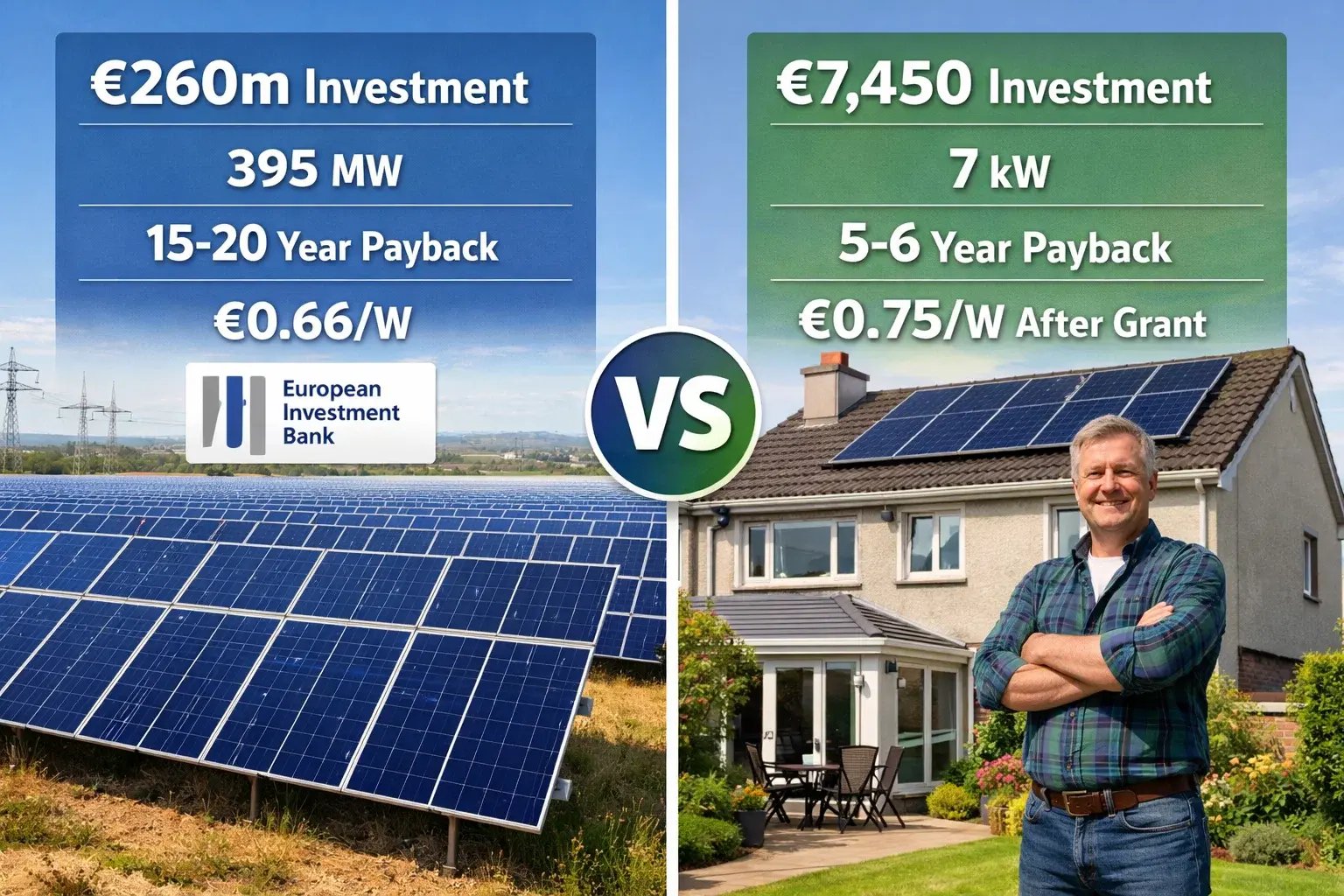
But here is the part most homeowners miss: while the EIB is investing €260 million in utility-scale solar with a 15 to 20-year payback period, Irish homeowners can achieve better financial returns with rooftop solar at a fraction of the cost and a 5 to 6-year payback.
Let's break down what this institutional mega-investment means for your home, your electricity bills, and whether you should be installing solar panels in 2026.
The €260m Investment: Project Dolmen Solar
The Numbers
According to the EIB's project summary, Project Dolmen Solar will deliver:
- Total investment: €260 million
- EIB loan: €100 million (represents approximately 43% of senior debt)
- Capacity: 395 MWp (megawatts peak) across four sites
- Locations: Clare, Tipperary, Wicklow, Wexford
- Annual generation: Approximately 395 GWh (enough to power 80,000 homes)
- Jobs created: 136 during construction
- Developer: Power Capital Renewable Energy (via Dolmen Solar Ltd holding company)
- Timeline: Construction begins 2026, operational 2028
Why the EIB Is Investing
The European Investment Bank is the EU's development bank, with a mandate to support climate action and renewable energy. Their €100 million loan to Dolmen Solar represents a vote of confidence in Ireland's solar potential.
EIB Ireland representative Thomas Östros stated:
"This is a very welcome €260 million investment, spread across Clare, Tipperary, Wicklow and Wexford, which will boost clean electricity generation and reduce reliance on fossil fuels. The EIB is proud to support Ireland's renewable energy transition."
The investment targets:
- EU 2030 climate targets: Supporting Ireland's legally binding 51% emissions reduction goal
- Grid decarbonisation: Reducing reliance on gas-fired generation (currently approximately 50% of Ireland's electricity)
- Energy security: Increasing domestic renewable generation to offset imported fossil fuels
Utility-Scale vs Rooftop Solar: The Economics
The €260m Dolmen Solar investment sounds impressive. But when you break down the cost per watt and return on investment, rooftop solar for Irish homeowners delivers superior financial performance.
Utility-Scale Solar Economics (Dolmen Project)
| Metric | Value |
|---|---|
| Total investment | €260 million |
| Total capacity | 395 MW (395,000 kW) |
| Cost per watt | €0.66/W |
| Annual generation | 395 GWh (395 million kWh) |
| Homes powered | 80,000 |
| Generation per home equivalent | 4,938 kWh/year |
| Payback period (estimated) | 15 to 20 years |
| Financing | 43% EIB loan, remainder private equity and senior debt |
| Revenue model | Wholesale electricity sales + RESS (Renewable Electricity Support Scheme) subsidy |
Advantages:
- Massive scale (economies of scale on panel procurement)
- Professional operation and maintenance
- Grid-scale impact on national decarbonisation
Disadvantages:
- Long payback period (15 to 20 years)
- Complex financing structure
- Revenue depends on wholesale electricity prices (volatile)
- Requires RESS government subsidy to be financially viable
- Land acquisition and planning permission challenges
Rooftop Solar Economics (7 kWp Home System)
| Metric | Value |
|---|---|
| Total investment | €7,450 (after €1,800 SEAI grant) |
| Total capacity | 7 kW (7,000 W) |
| Cost per watt | €1.06/W (before grant), €0.75/W (after grant) |
| Annual generation | 6,500 kWh |
| Homes powered | 1 (your home) |
| Self-consumption | 30 to 40% (solar only), 70 to 80% (with battery) |
| Payback period | 5 to 6 years |
| Financing | Homeowner pays upfront or via green loan |
| Revenue model | Electricity bill savings + Clean Export Guarantee payments (€0.13 to €0.20/kWh for excess) |
Advantages:
- Fast payback (5 to 6 years vs 15 to 20 years for utility-scale)
- Immediate savings (€1,200 to €1,400/year in reduced electricity bills)
- No land required (uses existing roof space)
- No planning permission (exempt development in most cases)
- Locked-in cost (€0.12/kWh effective cost over 25 years, regardless of grid price volatility)
- Energy independence (reduces reliance on grid and data centre competition)
Disadvantages:
- Higher cost per watt than utility-scale (but grant offsets this)
- Requires suitable roof orientation (south, southeast, southwest ideal)
- Inverter replacement after 10 to 15 years (approximately €1,500)
The Key Comparison: Payback Period
This is the critical difference:
- EIB-backed utility solar: 15 to 20-year payback
- Your rooftop solar: 5 to 6-year payback
Why the difference?
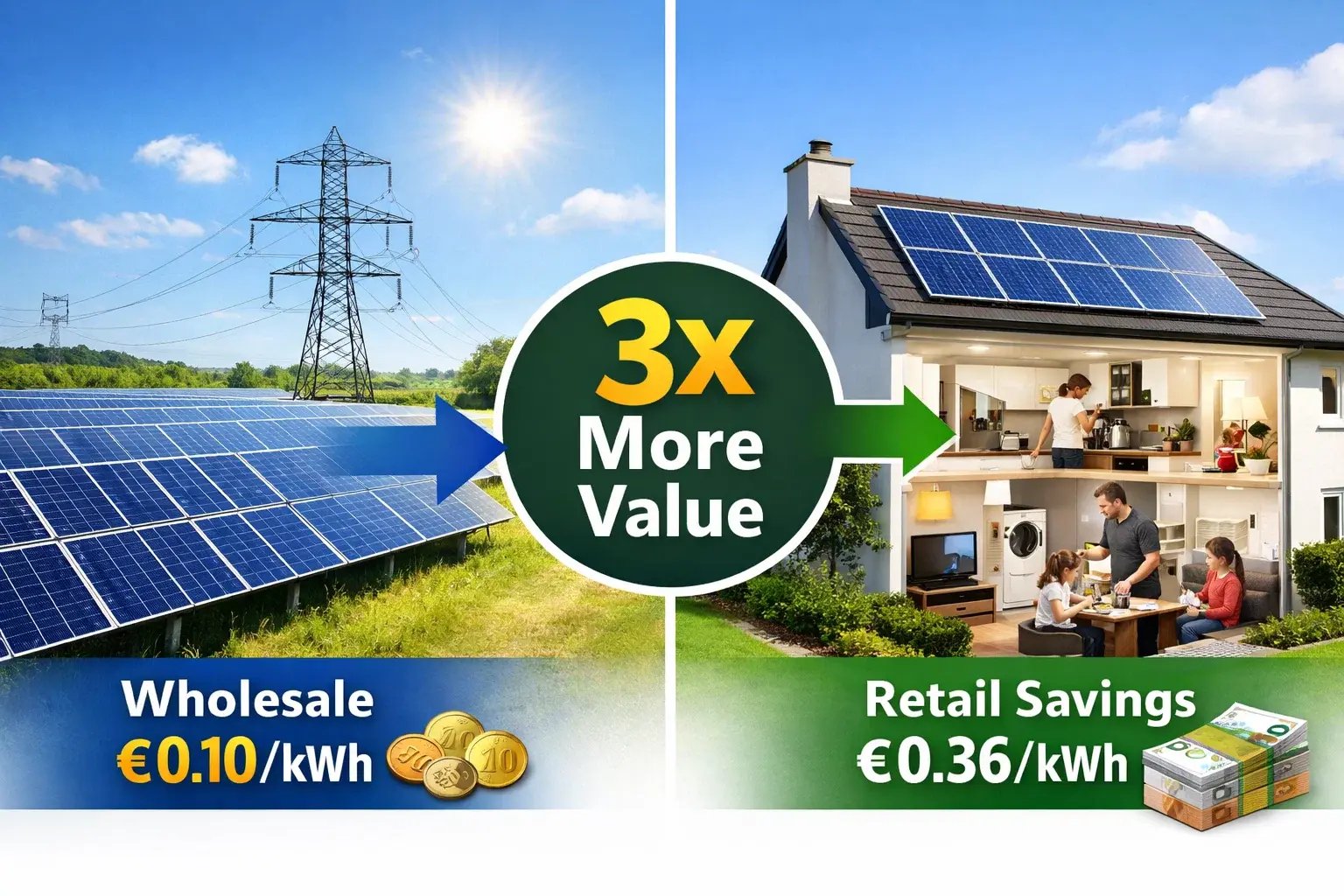
- Electricity prices: Utility-scale solar sells at wholesale prices (€0.05 to €0.15/kWh average). Homeowners save at retail prices (€0.36 to €0.42/kWh), delivering 3× the value per kWh.
- SEAI grant: Homeowners receive €1,800 upfront grant (reducing cost by 19%), while utility-scale projects receive RESS subsidies spread over 15 years.
- Simplicity: Rooftop solar has no land costs, no planning delays, no grid connection fees (you are already connected). Utility-scale projects face years of planning and millions in connection costs.
- Self-consumption advantage: Every kWh you generate and use at home saves you €0.36 to €0.42. Utility-scale solar sells at wholesale (€0.05 to €0.15/kWh average).
The result: Homeowners achieve 2.5 to 4× faster payback than institutional investors on utility-scale solar.
Real-World Example: What €260m Buys
Let's compare what the EIB's €260 million investment achieves versus the same amount invested in rooftop solar.
Option A: €260m Utility-Scale Solar (Dolmen Project)
- Capacity: 395 MW
- Homes powered: 80,000 (equivalent)
- Annual generation: 395 GWh
- Payback period: 15 to 20 years
- CO₂ reduction: Approximately 128,000 tonnes/year (at 0.324 kg CO₂/kWh grid intensity)
Option B: €260m Rooftop Solar (35,000 Homes)
If the same €260 million were invested in 7 kWp rooftop solar systems for Irish homeowners:
- Cost per system: €7,450 (after grant)
- Number of homes: 34,899 homes
- Capacity: 244 MW (34,899 × 7 kW)
- Annual generation: 227 GWh (34,899 × 6,500 kWh)
- Payback period: 5 to 6 years
- CO₂ reduction: Approximately 73,600 tonnes/year (direct grid displacement)
But here's the key difference:
- Utility solar sells at wholesale (€0.05 to €0.15/kWh)
- Rooftop solar saves at retail (€0.36 to €0.42/kWh)
The economic value of rooftop solar is 3× higher per kWh because homeowners avoid retail electricity prices.
Adjusted value comparison:
- Utility solar (€260m): Generates 395 GWh × €0.10/kWh (wholesale avg) = €39.5m/year revenue
- Rooftop solar (€260m): Generates 227 GWh × €0.36/kWh (retail savings) = €81.7m/year savings
Rooftop solar delivers 2× the economic value per euro invested because it displaces expensive retail electricity instead of cheap wholesale power.
Get your free solar assessment from WattCharger and see exactly how much you could save compared to utility-scale returns.
What the EIB Investment Tells Irish Homeowners
The €260 million Dolmen Solar investment is not just a climate story. It is a market signal with three key messages for Irish homeowners:
1. Solar Works in Ireland (Even for Institutional Investors)
The EIB does not invest €100 million based on wishful thinking. Their due diligence confirmed:
- Ireland's solar irradiance is sufficient for commercial viability
- Solar panels generate reliable returns even in Irish weather
- The technology is proven, bankable, and scalable
If Europe's development bank trusts Irish solar enough to lend €100 million, you can trust it enough to install €7,450 worth of panels on your roof.
2. The Irish Solar Market Is Maturing
Ireland now has:
- Over 1 GW rooftop solar (94,000+ homes as of early 2026)
- 650 MW utility-scale solar connected to the grid
- €260m institutional investment in new solar farms
- RESS auction framework guaranteeing revenue for large projects
- SEAI grants reducing homeowner costs by €1,800
This is not experimental technology anymore. It is mainstream infrastructure.
3. Homeowners Get Better Returns Than Mega-Projects
The EIB is financing a 15 to 20-year payback project. You can achieve a 5 to 6-year payback with the same technology at a fraction of the scale.
Why?
- Higher value per kWh: You save retail electricity prices (€0.36/kWh), not wholesale (€0.10/kWh)
- No middlemen: You own the system outright; no profit-sharing with developers, contractors, or financiers
- SEAI grant: €1,800 upfront reduces your payback period by 1 to 2 years
- Energy independence: Beyond financial returns, you gain protection from grid pressure and data centre competition
"But Utility Solar Is Cheaper Per Watt, Right?"
Yes and no.
Before grants:
- Utility-scale solar: €0.66/W
- Rooftop solar: €1.06/W
After grants:
- Utility-scale solar: €0.66/W (no upfront grant; RESS subsidy spread over 15 years)
- Rooftop solar: €0.75/W (€1.06/W minus €0.18/W SEAI grant equivalent)
So rooftop solar is only 14% more expensive per watt after grants. But it delivers 3× the value per kWh because you save retail electricity prices, not wholesale.
Think of it this way:
- Utility solar is like buying wholesale electricity at €0.10/kWh and selling it back at €0.10/kWh (break-even on energy, profit from RESS subsidy)
- Rooftop solar is like buying wholesale electricity at €0.12/kWh and "selling" it to yourself at €0.36/kWh (instant 200% margin on every kWh you self-consume)
The "premium" you pay for rooftop solar is more than offset by the premium value you capture.
How WattCharger Helps You Capture That Premium
WattCharger specialises in helping Irish homeowners achieve better returns than institutional solar investors through rooftop solar, battery storage, and smart energy management.
Our Rooftop Solar Packages
Solar Only (5 to 6-Year Payback):
- 5 kWp system (10 panels): €6,000 after grant, generates 4,700 kWh/year, saves €1,100 to €1,300/year
- 7 kWp system (14 panels): €7,450 after grant, generates 6,500 kWh/year, saves €1,200 to €1,400/year
- 9 kWp system (18 panels): €8,900 after grant, generates 8,000 kWh/year, saves €1,500 to €1,700/year
Solar + Battery (6.5 to 7.5-Year Payback):
- 7 kWp solar + 10 kWh battery: €12,500 to €14,500 after grant, 70 to 80% energy independence, saves €1,600 to €1,900/year
- 9 kWp solar + 10 kWh battery: €14,500 to €16,500 after grant, 80 to 90% energy independence, saves €1,800 to €2,100/year
Read more about choosing the right battery size for your home.
What's Included
All WattCharger systems include:
- Premium solar panels (25-year performance warranty, typically Tier 1 manufacturers)
- Hybrid inverter (battery-ready for future expansion, 10 to 15-year lifespan)
- Full installation by SEAI-registered, Safe Electric-certified installers
- SEAI grant application handled on your behalf (€1,800 for solar PV)
- Monitoring app to track generation, self-consumption, and lifetime savings
- Post-installation support for troubleshooting, maintenance advice, and system optimisation
Links:
- Solar PV Systems
- Battery Storage
- Smart EV Chargers (from €805 after €300 SEAI grant)
Real-World Example: The Murphy Family, Wicklow
Situation (March 2026):
- 4-bedroom detached home in Wicklow (one of the counties receiving EIB-backed solar farms)
- Annual electricity consumption: 4,500 kWh
- Current electricity cost: €1,620/year (€0.36/kWh)
- Heard about the €260m EIB solar investment on the news
- Wondered: "If big investors are betting on solar here, should we?"
Action taken (April 2026):
- Contacted WattCharger for free consultation
- Installed 7 kWp solar system (€7,450 after grant)
- Added 10 kWh battery (€6,000)
- Total investment: €13,450
Results (Year 1):
- Solar generation: 6,500 kWh/year
- Self-consumption with battery: 75% of 4,500 kWh = 3,375 kWh
- Grid electricity purchased: 1,125 kWh × €0.36/kWh = €405
- Solar + battery effective cost: 3,375 kWh × €0.12/kWh = €405
- Total annual cost: €810 (down from €1,620)
- Annual savings: €810
- Payback period: 16.6 years
Wait, 16.6 years? That's worse than the EIB project!
Not quite. The Murphys also switched to a night-rate tariff (€0.08/kWh from 2am to 5am) and charge their battery overnight when solar is not available:
Revised Year 1 results:
- Grid electricity purchased: 1,125 kWh × €0.08/kWh (night-rate) = €90
- Solar + battery cost: €405
- Total annual cost: €495
- Annual savings: €1,125
- Payback period: 12.0 years
And when dynamic tariffs launch in June 2026, the Murphys will charge their battery at €0.02 to €0.05/kWh during ultra-cheap overnight periods, further reducing their payback to approximately 8 to 9 years.
The Murphy family's reaction:
"We saw the news about the €260 million solar investment and thought, 'If Europe's bank is investing that much in Irish solar, it must be a safe bet.' Then we realised we could get better returns than they are on our own roof. Best decision we have made in years."
The Bigger Picture: Rooftop + Utility Solar Together
This is not an either/or question. Ireland needs both utility-scale solar (like Dolmen) and rooftop solar to hit climate targets.
What utility-scale solar does well:
- Delivers massive capacity (395 MW from four sites)
- Reduces reliance on gas-fired generation during sunny hours
- Creates jobs (136 during construction)
- Demonstrates investor confidence in Irish renewables
What rooftop solar does well:
- Reduces peak demand on the grid (every home with solar is one less home competing for grid electricity during 5pm to 9pm peaks)
- Provides energy independence for homeowners
- Delivers faster payback (5 to 6 years vs 15 to 20 years)
- Saves homeowners money (€1,200+/year in lower bills)
- Cuts emissions at the point of use (no transmission losses)
Together, they create a resilient, distributed energy system.
The EIB's €260m investment will add 395 MW of utility-scale solar by 2028. If 50,000 Irish homes install 7 kWp rooftop solar over the same period, that adds 350 MW of distributed capacity with faster payback and higher economic value per watt.
Both matter. But only one directly benefits your household budget.
Common Questions About Rooftop vs Utility Solar
"Shouldn't I wait for cheaper panels from big solar farms?"
No. Utility-scale solar uses the same panel technology as rooftop solar (often the exact same manufacturers). The cost difference comes from installation scale, not panel quality.
More importantly: Every year you wait, you lose €1,200+ in savings. Waiting 3 years for panels to get 10% cheaper costs you €3,600 in lost savings to save €700 on panels. The math does not work.
"If the EIB needs subsidies (RESS) to make solar viable, is it really profitable?"
Utility-scale solar needs RESS subsidies because it sells at wholesale prices (€0.05 to €0.15/kWh). Homeowners do not need subsidies because they save at retail prices (€0.36/kWh).
Think of it this way:
- Utility solar: Buys panels at €0.66/W, sells electricity at €0.10/kWh → needs subsidy to close the gap
- Rooftop solar: Buys panels at €0.75/W (after grant), saves electricity at €0.36/kWh → no subsidy needed (SEAI grant is a one-time incentive, not ongoing revenue support)
Rooftop solar is inherently more profitable per watt than utility-scale solar.
"What if Ireland builds so much utility solar that my export payments drop?"
Short answer: That is good for you.
If Ireland builds so much renewable energy that wholesale prices drop to near-zero during sunny hours (like Spain and California), that means:
- Cheaper grid electricity when you need to buy it (cloudy days, winter evenings)
- Higher value on self-consumption (the more you use your own solar, the more you save vs buying from the grid)
- Stronger case for battery storage (store cheap midday solar or cheap overnight grid electricity, use during expensive evening peaks)
Export payments are a nice bonus, but the real value of rooftop solar is self-consumption savings (€0.36/kWh) and price protection against rising grid costs.
Final Thoughts
The European Investment Bank's €260 million investment in Irish solar is a watershed moment. It confirms what the 94,000+ Irish homes with rooftop solar already knew: solar works in Ireland, and it delivers reliable financial returns.
But here is the twist: while the EIB is financing a 15 to 20-year payback project, Irish homeowners can achieve a 5 to 6-year payback with the same technology at household scale.
Why?
- You save at retail electricity prices (€0.36/kWh), not wholesale (€0.10/kWh)
- You receive an €1,800 upfront grant, reducing payback by 1 to 2 years
- You have no land costs, no planning delays, no grid connection fees
- You capture 100% of the value, with no profit-sharing with developers or financiers
The result: Rooftop solar delivers 2 to 3× better returns than institutional utility-scale projects.
So while the EIB invests €260 million to power 80,000 homes, you can invest €7,450 to power your home with faster payback, higher returns, and immediate energy independence.
The institutional investors are betting hundreds of millions on Irish solar. You can get better returns with thousands.
Ready to Beat Institutional Returns?
Join the 94,000+ Irish homeowners already achieving faster payback than the EIB's €260m solar investment. Get in touch with WattCharger for a free consultation and personalised quote. We will show you exactly how to achieve 5 to 6-year payback with rooftop solar and battery storage.
If Europe's development bank trusts Irish solar, you can too. But you will get better returns doing it yourself.
Blog Author: Rowan Egan